Wednesday, June 10, 2026

About Mormons


A popular local radio host who happens to be Mormon recently posted an article about how Mormons are Christians.

Strictly speaking, they are not.

Catholic Answers has an article that explains how Mormon teachings stray from Christian teachings. They certainly do a better job than I could!

....

“Good morning, sir. I’m Elder Lamb and this is Elder Sanders. We’re from the Church of Jesus Christ of Latter-day Saints and we have an important message for you. May we come in?”

If you let them in, you’ve invited them to begin the process of “discussions,” six canned lessons they’ve been trained to deliver, leading, ideally, to your baptism into the Mormon Church.

They’ll begin by telling you the Heavenly Father has a plan for your eternal happiness. Jesus Christ and Joseph Smith are central figures in this plan of salvation. Both prophets, ancient and modern, reveal the purpose and will of God. The Book of Mormon is additional scripture testifying to the message.

The lessons last about an hour each and are spread over four to six weeks. On their second and subsequent visits, the young missionaries will urge you to repentance, faith in their doctrines, baptism into their church, and moral living. Only their church, they say, can lead you to true righteousness and ultimate salvation. All other so-called Christian churches profess creeds abominable to the Lord and offer only counterfeit holiness (Joseph Smith, History 1:19; found in the Mormon book of scripture The Pearl of Great Price). Shortly after the death of the apostles, Mormons claim, the pure Christian faith was overtaken by false doctrine and vanished totally from the earth. This “apostasy” was reversed and the true Church was restored in 1830 in upstate New York by the boy-prophet, Joseph Smith.

If you live a life obedient to LDS dictates, you can progress to the point of perfection. You will become like God and return to him in his highest heaven. Provided your spouse, children, and parents live equally dedicated lives, you will spend eternity with them as a family.

Requirements for this eventual “exaltation” include living the “Word of Wisdom,” or abstaining from coffee, tea, alcohol, and tobacco; tithing, or paying to the Church one-tenth of your income; fulfilling all Church responsibilities; and dedicating all your energy to spreading the Mormon gospel.

Not an unattractive message, on the face of it. Some spiritual seekers are drawn by the Mormon challenge of sacrificial living and giving. Ignorant of the orthodox Christian teaching on salvation and eternal life, many suffering the loss of a loved one find consolation in the Mormon teaching on eternal families. Culling an occasional spiritual kernel from the Book of Mormon, prospective converts conclude both it and its ecclesiastical publisher present divine truths.

But Mormons, whether missionaries, neighbors, or colleagues, are trained to present only the “milk” beliefs, the bland and less offensive teachings designed to hook the unsuspecting. The “meatier” doctrines are kept for later-much later. Indeed, many faithful members know little or nothing of their Church’s fundamental tenets.

Here are some of them.

1. God the Father is a glorified man, possessing a physical body.

That is, the Almighty Lord was once born of human parents in some other universe. He lived a Mormon way of life, repented of his sins, died, and was eventually raised by his God and installed as God of this world.

Mormons justify this belief by mishandling and misunderstanding such biblical texts as Genesis 1:26-27, Exodus 33:11, Deuteronomy 4:34, Psalms 33:18, and Nahum 1:3. Most of these passages, and others like them, refer to the “arm,” “eye,” and “feet” of the Lord. However, other passages speak of God’s “feathers” and “wings” (Ps. 91:4). Or they refer to him as a “consuming fire” (Deut. 4:24) or a “rock” (Deut. 32:4). In all these examples, the inspired writers simply try to communicate in human words and images the inexpressible power, presence, and love of the infinite God.

Latter-day Saints force the context of Genesis 1:26-27. Since man is made in God’s image, they argue, God must look like a man. Though the Genesis passage states God created man both male and female, Mormons insist that God the Father is a male. The fact is, “the image of God” refers not to some literal correlation of body parts but to the spiritual similarities shared by him with his rational creatures (angels and human beings). In other words, we are made in God’s image because we, like him, can choose and can love. We are endowed with the possibility of such moral and intellectual qualities as holiness, wisdom, and justice. By these, we enjoy spiritual fellowship, even sonship, with the Father and “pattern” of our spirits.

When confronted by Mormons with their belief in an almighty Heavenly Father, ask them about his origins. Was there ever a time he didn’t exist? Was he always God? Did he ever commit sin? (Mormon apostle Bruce R. McConkie taught that the Father “worked out his own salvation by obedience to the same laws” he has since given us. [A New Witness for the Articles of Faith, 64]). If he has a body of flesh and bones, where is it? (On a planet near the star Kolob, Mormons maintain. See Abraham 3:3 in The Pearl of Great Price. )

Help Latter-day Saints to see the true nature of God: He is infinite Spirit (John 4:24). A spirit does not have flesh and bones (Luke 24:39). God is not a man, even an exalted one (Num. 23:19; Hos. 11:9). God was always God; he is immortal, and he is all-holy (1 Tim. 1:17). No one can see the “face” of God and live (Ex. 33:20, John 1:18).

2. There are many Gods.

Mormons will tell you they believe in one God whom they call the Heavenly Father. They worship and pray to him alone. But-referring to Genesis 1:26-27 and 1 Corinthians 8:5-Latter-day Saints insist the ancient Jewish patriarchs and prophets, along with Paul and the other apostles, believed in a plurality of Gods.

If you press them, they respond, “Look, God himself taught Mormon doctrine. See here, God says, ‘Let us make man in our image’ [Gen. 1:26]. He was talking to His Son, Jesus Christ, and the spirit-man, the Holy Ghost. Right there, then, you’ve got three Gods. Those three Gods oversee our universe. The Father is supreme, and the other two are his helpers.”

At first blush, the Mormon apologist has confused three distinct persons of the Trinity with three separate Gods. But it gets worse. Paul, they maintain, knew of other Gods when he wrote to the Corinthians: “For there be [those] that are called gods, whether in heaven or in earth (as there be gods many and lords many), but to us there is but one God” (1 Cor. 8:5-6). Therefore, Mormons assert, there are as many supreme Gods as there are worlds. Brigham Young taught that the number of Gods and worlds is uncountable (Discourses of Brigham Young, 22). The LDS Church occupies itself with only the one (or three?) Gods of this world and leave it to inhabitants of other universes to worship and obey their respective Gods.

As for the Genesis citation, no Jewish or Christian commentator sees the least hint of polytheism in the use of the plurals “us” and “our.” While the Hebrew word for God, Elohim, is in plural form, and therefore must be replaced by plural pronouns, the rest of the passage is in the singular: “God created (singular verb) man in his own image.” Various interpretations are consistent with the biblical revelation of monotheism. For example, the Lord may have simply used the “plural of majesty”-rather like a monarch and, until recently, the pope, who often referred to himself as “we.” Or God may have been addressing his heavenly court of angels, who also possessed the image of God in that they were rational beings endowed with knowledge, will, and immortal life. Further, Christians may comfortably conclude the Father was indeed communicating with the Son and the Holy Spirit, who, as mighty God, exist dynamic and creative from all eternity.

Paul did not teach a plurality of Lords and Gods. He merely commented that there are entities that are called gods. Whether he was referring to the crass idols of Zeus or Hermes, or craftier masters such as greed and pride, he-and we-know that men have created and will continue to create other gods and lords, displacing the one true God. We do not merely limit our adoration and service to one God among millions; we don’t, in fact, know of any other God.

You can help the Mormon see the fallacy of multiple infinite beings. While not explicitly presented in the Bible, the doctrine of the Trinity is imbedded in Scripture’s insistence on one only God and its clear teaching that the Father, the Son, and the Holy Spirit are persons possessing equal majesty, power, and lordship. They are not united solely in purpose or will, as Mormons assert, but in very being. Read Isaiah 42-45 to find crystallized the ancient Hebrew belief in one God. Christ and his followers confirm monotheism in John 17:3, 1 Corinthians 8:4, Galatians 3:20, and Ephesians 4:6. The Son is called God throughout Christian scripture. See John 20:28 and Hebrews 1:8. Similarly, the Holy Spirit is confessed as God in Acts 5:3-4 and 2 Corinthians 3:17. If the Father is God, the Son is God, and the Holy Spirit is God, yet there is only one God, then only the truth revealed in the Blessed Trinity can explain Scripture’s doctrines.

3. A man can become God.

He can’t become God of this world, mind you, since that position is already filled. But a man who lives as a faithful Mormon in this life, fulfilling all obligations imposed on him by the LDS Church, may progress to godhood in the next life. He will be given his own world to populate and rule, together with his heavenly wife or wives (including, usually, his own earthly Mormon spouse).

Spencer W. Kimball, Mormon prophet during the 1980s, declared to a group of male college students: “Each one of you has it within the realm of possibility to develop a kingdom over which you will preside as its king and God. You will need to develop yourself and grow in ability and power and worthiness to govern such a world with all of its people” (Doctrines of the Gospel Student Manual, 29). So, having achieved divinity, a man will do for his own creation all that the Heavenly Father has done for him. In turn, he will be worshiped as God by the children he procreates, just as he now adores and obeys God the Father.

Because Mormons see God as an advanced and perfected man, they conclude that their members enjoy a similar progression. They confuse Christ’s admonition to “be perfect” (Matt. 5:48) with “become a God.” In fact, since there is but one God, man’s perfection lies in becoming fully conformed to the divine image in which Adam was created. He is to become a perfect man, aided by the grace brought by the Second Adam, Jesus Christ.

Try to get Latter-day Saints to see that an earthly parent-child analogy cannot apply to our relationship with the Lord. An earthly father’s task is to raise his son to become self-supporting and independent, autonomous in his decisions. It is not so between God and us. We’ll never achieve his status; we’ll never grow apart from him; we’ll always need him. Yes, we shall enjoy fully his communicable attributes of eternal life, love, and goodness. Like a bar of iron, we’ll glow with divine fire (2 Pet. 1:4.) The boundaries between perfect humanity and divine glory may appear blurred. But they won’t be eliminated. We’ll always be his perfected children, never his equal.

When pushed, Mormons will say we can never achieve God’s status, and we’ll never be equal to him. But that’s just an attempt to soften the offense of this doctrine. What they mean is, since the present God has a long head start, we’ll never catch up to him in power and glory. He advances as we do. But a Mormon man, once on the path of progression, may one day arrive at the level God is at now. Then his own sons, becoming Gods in their turn, will push him even further along, into the eternities.

4. Jesus Christ: half-God, half-man.

According to a text published by the LDS Church for use by college-age students, Jesus Christ was “the only man born to this earth half-divine and half-mortal” (The Life and Teachings of Jesus and His Apostles, 10). Mormonism teaches that matter is eternal. That which we call “spirit” is really just highly refined matter. Therefore, God didn’t create from nothing; He merely “organized” pre-existent matter. This includes the “spirit” form of his Son, Jesus Christ, whom the Heavenly Father and one of his heavenly wives created as their first-born. (Lucifer and his minions, together with every other person, were similarly conceived in the heavens, thus making us all Christ’s junior brothers and sisters.)

Two thousand years ago, the Heavenly Father looked with favor upon his daughter, the Virgin Mary. He visited her in his flesh-and-bones male body and had sexual intercourse with her. The result was Jesus Christ in his mortal body. Since Mormons say they believe Mary was a virgin when she conceived her son, LDS theologians have had to redefine the definition of “virgin.” They say a virgin is a woman who has not had sex with a mortal man; since God the Father was by then an immortal man, no loss of virginity occurred, though “normal and natural” intercourse took place (Bruce R. McConkie, The Mortal Messiah, vol. 1, 314; Mormon Doctrine, 546-547). An early Mormon apostle taught that God the Father and Mary were “associated together in the capacity of husband and wife” (Orson Pratt, The Seer, 158-159).

Many Latter-day Saints believe Christ was married and had children. Because marriage is the only way a man can become a God in the next life, should not the Lord have taken a wife (or wives) and shown us how to live worthily? Since the blessings of marriage are crowned by the birth of children, Christ is said to have had several. While such notions were taught openly during the Mormon presidencies of Joseph Smith and Brigham Young, the current membership is cautioned not to throw such spiritual pearls before scoffing swine. (See apostle Orson Hyde, Journal of Discourses2:210 and 4:259-260; also, president Jedediah M. Grant, Journal of Discourses 1:346.)

Latter-day Saints will not worship Christ. They are forbidden to pray to him. All prayer is directed to the Father only, in the name of the Son. Because they don’t understand the true nature and persons of God, Mormons confuse the divine and human natures of his Son. For them, Christ must be a lesser God, since he (and the Holy Ghost) were formed by the Father and are subjected to him in all things. Though now Gods, Christ and the Holy Spirit became Gods later than did Heavenly Father and are totally dependent upon him who created them.

Biblical verses supporting the Holy Trinity and the full deity of the three persons are also useful here, to establish that Christ is mighty God from all eternity. He accepted and expects adoration. He received Thomas’s worshipful phrase, “My Lord and my God” (John 20:28) without demurral; see also Matthew 2:11 and 28:9, 17; John 9:38; and Revelation 5:14.

Keep in mind that Mormons maintain these doctrines are part of the truth revealed by God in every age to his Church. Abraham, Moses, Isaiah, and all the prophets knew and taught God had a physical body, knew and taught a plurality of Gods, knew and taught that men can evolve into Gods, and knew and taught a subordinate Christ. The same is true for the first apostles chosen by Christ two thousand years ago. Such glorious doctrines were lost, the Mormon Church declares, because the Catholic Church, after having replaced the true Church of Christ, removed many “plain and precious” truths from the scriptures. The world was thus enthralled in the blackness of apostasy until the Lord restored all these teachings to Joseph Smith in 1830.

5. In the Mormon Temple, God gives men all the secrets necessary for salvation.

It is in their temples, Latter-day Saints are told, where the full purity of these restored teachings is revealed. The temple ceremonies, written by Joseph Smith soon after he became a Freemason and containing many Masonic parallels, are said to replicate the rituals performed in the temples of Solomon and Herod.

Only those worthy to enter the temple may return to God after death. About twenty percent of Mormons hold “recommends,” cards permitting them entrance to the temple where the secret ceremonies are performed. The so-called “restored” gospel teachings presented above are emphasized visually in a video. I’ve been through the “endowment” ritual several times. It takes about ninety minutes. The words and actions never vary. The temple patron hears the Gods’ plan for creating the world and mankind. The patron makes “covenants” with the Lord to support the Mormon Church in every way he can. He promises not to speak critically of Mormon leaders and to avoid loud laughter. He promises to live a righteous and faithful life.

Throughout the presentation, the patrons are taught special “signs” and “tokens” consisting of various arm gestures and handc.asps, each having sacred names. Participants also don special clothing and head coverings during the endowment.

Temple attendance is obligatory for ultimate salvation. Even if you live a good, holy, Mormon life, assenting to its doctrines and participating in church activities, after death you cannot enter the presence of God without giving him the same signs and tokens and code names learned in the temple. Since to speak of these outside of the temple walls is forbidden, those who desire eternal life must pay the price to enter the temple. (“Pay the price” is not restricted to cash contributions, though to be temple-worthy you must give the church ten percent of your income, plus additional offerings.)

While a Mormon, I lived a life worthy of the temple. I tried hard to be prepared, praying and often fasting before attending an endowment session. But never did I “feel” the promised “Spirit of the Lord” within its walls or during its banal ceremonies. They were rote, repetitious, lifeless, and even silly. (Some Fundamentalist detractors pretend to uncover bizarre satanic or sexual overtones to the temple rituals. Nothing is further from the truth. Since being purged in 1990 of most anti-Catholic references and threats of disembowelment for revealing their secrets, the temple ordinances are now rather bland and-except for their theology-inoffensive.)

God doesn’t appear to be the focus of temple work. There is practically no prayer as such. Each patron is required to listen to the instructions, learn the signs and names, and repeat them accurately. Since the teachings, signs, and gestures never vary, the ceremony becomes quickly familiar. Those who attend do so in the belief that their performance here will enable those who were not Mormons on earth the chance to become saints in “spirit prison.” Some Mormons even boast of going through three or four sessions a day and thus “saving” three or four dead friends or relatives.

The Mormons who come knocking on your door need to know that God is Lord of all. He has revealed himself fully in his Son (Heb. 1:2), who himself charged his apostles to preach the gospel until the end of time (Luke 10:16; 2 Tim. 2:2; 4:2-4). He does not hide himself from his people, but desires they all be saved. He taught the truth openly (Matt. 26:55, John 8:2) and founded a Church to hand it down to every generation (2 Thes. 2:15, 3:16).

There’s no need for temples to teach us the secret way to salvation. That path was made clear by Christ, the light of the world, and is in every age illuminated by his body, the Catholic Church. Christ’s promises of power and permanence, once made, are irrevocable. (See Matthew 16:18, 28:20; John 14:16, 26; 16:13; Eph. 5:29.) The Church has preserved the purity of Christian faith and life. No “former” truths need be “restored” and secretly “revealed.”
Mormonism attracts largely by holding back its offensive doctrines and leading instead with its strong suit of family values and patriotic devotion. But “There is a way which seems right to a man, but its end is the way to death” (Prov. 14:12). See also 2 Corinthians 11:14: “Even Satan disguises himself as an angel of light.” The “good fruit” of Mormonism is poisoned by counterfeit theology.


Pax et bonum

Monday, June 8, 2026

Moving on up ...


This past weekend I was at a regional Secular Franciscan meeting. It’s an annual meeting of the ministers from the region (which covers most of New York state), along with a few other people from each fraternity in the region. I’m the minister of my fraternity. At the regional meeting we were approving a regional budget, hearing talks, meeting with national officials, and voting for our new council to guide our region for the next three years.

I’m part of that new council - a councilor. 

I hadn’t planned on running for an office, though it had been on my mind. At our regional visitation back in May the councilor visiting my fraternity strongly suggested that a couple of us consider running for a regional office. Part of me was thinking that as a professed Secular Franciscan I need to serve the Order as best I can. I need to make use of any gifts I might have. I was aware that in almost every organization to which I have belonged I almost always end up in some kind of leadership position - president, editor, principal, minister, and so on.

When the nominations came out in the days before the regional meeting, I realized that there was just one candidate for each office. Hardly an election!

So, I decided to toss my hat in for one of the councilor positions. There are four of them, and there were four candidates. I figured if I submitted my name there would at least be a choice. I contacted the Regional Minister to say I was thinking about it, and she encouraged me. She even said she would be happy to nominate me at the meeting as I had not been on the initial approved list!

When we gathered for the regional meeting one of the other candidates for councilor approached me. She said she had decided to retire from her job and that she and her husband were planning to move back to her homeland, France, next year. Realizing she could not complete a three-year term, and knowing that I was now running, she had decided to withdraw her name. She thanked me.

Yikes.

I got elected. Today at Mass we were officially installed.

For the next three years I will be a councilor for the St. Kateri Tekakwitha Region of the Secular Franciscan Order. I will also continue as minister of my fraternity.

As a councilor I will be helping to make decisions for the region. The council will have monthly meetings - primarily by Zoom as we are scattered across New York. I will also be assigned as the councilor for several fraternities in the region. I will visit those fraternities, oversee their elections, do visitations of them, and be the contact person for them if they have questions or concerns.

All that is good. But I realized some other things about me in light of this new office.

Being in a position of authority, I am even more of a public representative of the Order. I have to be more careful about what I do, what I say, what I write. I know I have a tendency toward sarcasm and snarky comments. I tend to be somewhat critical and political as well. I need to work on all that.

I also realize I have to do more to increase my Franciscan knowledge. I need to focus more of my reading on Franciscan books - spiritual works, biographies, histories, official documents, and so on. People will be looking to me as a resource; I have a responsibility to prepare.

The next three years are going to be interesting. Lord, be with me!

Pax et bonum

Tuesday, June 2, 2026

That Pride Thing (and Sports)


During this Month of the Sacred Heart of Jesus, activists and people with disordered conditions have tried to turn it into a month to celebrate and promote those conditions. Businesses, local governments, organizations all jumped on the bandwagon.

The steam has begun to go out of that effort. But, alas, some sports teams persist, pledging their support and calling for celebrating.

Recently, my favorite Major League Baseball team and my favorite National Football League team posted their support on social media.

I don’t really believe for a minute that either team really cares about the issue or the people with those conditions. I suspect a majority of their fans also don’t care. What teams care about is public relations and avoiding being targeted by a small group of loud-mothered, confrontational activists and their supporters.

What they really care about is money.

Never mind that they are helping to support and to promote these disordered conditions, and to help the confused, the lost, and the young astray.

Alas, like sheep, fans are so caught up in supporting their teams they keep quiet. By their silence they are complicit.

This is also an instance in which a word that might be positive is twisted by the propagandists who seek to normalize what is wrong or abnormal. Look what’s happened to words like “choice” or “gay.”

So here are a few quotations that help to restore order.

“It was pride that changed angels into devils.…” - St. Augustine

“Pride makes us artificial.…” - Thomas Merton

“Pride, the first peer and president of Hell.” - Daniel Defoe

“Where pride begins, love ceases.” - Johan Kasper Lavater

“With pride, there are many curses.” - Ezra Taft Benson

“Pride that dines on vanity, sups on contempt.” - Benjamin Franklin

“Pride is an admission of weakness; it secretly fears all competition and dreads all rivals.” - Bishop Fulton J. Sheen

“Pride is founded not on the sense of happiness, but on the sense of power.” - William Hazlitt

“Pride and excess bring disaster for man.” - Xunzi

“When pride and presumption walk before, shame and loss follow very closely.” - King Louis XI of France

“Pride goes before destruction.” - Aesop

“Pride must die in you, or nothing of heaven can live in you.” - Andrew Murray

“All men make mistakes, but a good man yields when he knows his course is wrong, and repairs the evil. The only crime is pride.” - Sophocles

Maybe the fans need to consider what “pride” really means, and maybe they need to let their teams know they are just interested in watching and enjoying a game, and not in having propaganda shoved down their throats.

As for me, I notified the Mets and the Bills about my displeasure with them bringing woke nonsense into their marketing.

And maybe I’ll find better things to do with my time than watching or going to their games. Write. Practice guitar and sing. Take a walk with my wife. Read a book.

Pax et bonum

Saturday, May 30, 2026

Some Recent Science Fiction and Horror Poetry


though in a coma
he was aware as doctors
harvested organs

Once,
twice,
and then
a third time
he heard the footsteps
of it circling his hiding place.

He
left
home to
travel to
Mars happy that he
might never see his wife again
not knowing she was
thinking the
exact
same
thing.

Two
robots
stood rusted
with batteries
dead.

The
dragon
hungrily
watched as the knight
neared.

First
arrest
for the clone
repeats source’s
crime.

we watched as the four
looped the dark side of the moon
so did other eyes

Cro-Magnon father
neanderthal mother
the story of us

they learned a diet
of garlic deters vampires
but not werewolves

the first warning sign
the shadows began moving
independently

he quickly learned
not all dreams are just dreams
teeth marks on his leg

how ironic -
we discover the werewolf
is Joe the barber

after a feasting
gave him a disease vampire
practices safe sucks

Pax et bonum

Friday, May 29, 2026

May 29 In Catholic History: Welcome G. K. Chesterton


On May 29, 1874, Gilbert Keith Chesterton was born in London.

A 1922 convert, Chesterton was a noted for his voluminous output of essays, poetry, plays, novels, debates, speeches, and spiritual works. He might be best known in the popular mind for creating Father Brown and the Father Brown mysteries. But his spiritual works include acclaimed biographies of St. Francis of Assisi and St. Thomas Aquinas, and two works often listed as spiritual classic of the 20th Century: Orthodoxy and The Everlasting Man

Chesterton, who died June 14, 1936, influenced later writers, including J. R. R. Tolkien, Dorothy Sayers, and, most famously, C. S. Lewis, who acknowledged that reading Chesterton helped to convert him from atheist to Christian. 
  
Pax et bonum

Wednesday, May 27, 2026

May 27 in Catholic History: The Future Cardinal O'Connor


On May 27, 1979, Pope St. John Paul II consecrated John O'Connor as a bishop. On May 19, 1984 he was installed as Archbishop of New York, and the following year, on May 25, he was elevated to Cardinal. He remained as Cardinal Archbishop of New York until his death on May 3, 2000.

Cardinal O'Connor was a staunch defender of life - opposing abortion, euthanasia, the death penalty, human trafficking, and unjust war. He created what was to become the Sisters of Life. The Sisters take a vow to "protect and enhance the sacredness of human life."[  

Pax et bonum

Tuesday, May 26, 2026

Are They Watching Us?


The U.S. government has been releasing UFO files. Okay, they now call them UAPs - “Unidentified Anomalous Phenomena”. Seriously? I'll stick with UFOs.

I don't know if there are aliens out there sending those objects. It's an interesting idea.

The release comes weeks after Artemis 2 flew around the moon, and, in fact, flew further into space than any crewed mission before.  

Which got me to wondering: Besides the humans on earth watching, could some of those possible aliens been watching? And if so, what were they thinking?

I was reminded of a classic science fiction movie: The Day the Earth Stood Still. The 1951 one, not the terrible 2008 remake. Klaatu, the alien, arrives with a gift, but it gets destroyed because of a trigger-happy human. Klaatu later notes that his people have been watching us with growing concern. We were too warlike and violent, we had nuclear weapons, and we were beginning to move out into space. We were viewed as a potential threat, and the implication is that if we continue our warlike ways and we do move into out space they might have to take action against us for the sake of interplanetary peace.

Now they may have been monitoring us by sending down UFOs. Maybe they were also monitoring our radio and television signals. Which is one of the plot devices for another science fiction movie, a comedy: Galaxy Quest. In that 1999 movie, a favorite of mine, the aliens had been watching television signals from earth, believing what they depict is true. They particularly like a science fiction show, Galaxy Quest (a parody of Star Trek) and not only built a working version of the ship in the show but modeled their culture on the culture depicted in the show. They also felt pity for Gilligan and his fellow castaways. Faced with attack, they come to earth to recruit help from the crew depicted on the show, bringing the actors up to their ship. Naturally, the actors, using their characters to help guide them, save the day.

A third movie could be taken as a warning, but also a sign of hope: Enemy Mine.

The 1985 movie has humans going into space and encountering an alien race, the Dracs, and promptly going to war with them. A human fighter pilot, Willis, and a Drac fighter pilot, Jariba (Jerry), crash on a planet, and gradually overcome their mistrust and hostility. They become friends. Jerry teaches Willis his family line - in the Drac culture that is important, and in doing so he is bestowing an honor on Willis.  Then Jerry becomes become terminally ill, but not before revealing he is carrying a child. He asks Willis to promise that he will take the child back to the Drac home world and recite for him his Drac family line.  Jerry dies, and Willis delivers the Drac child, Zammis. Willis raises Zammis, who calls him "Uncle". Then evil humans arrive to mine on the planet using Drac slave labor, brutally mistreating the Dracs. Zammis is captured by them, and Willis is shot and left for dead by the evil humans. Instead, he is rescued by other members of the space force, and when he recovers, he seeks out Zammis to rescue him. He does so, and takes him back to the Drac world, reciting the family line, and is honored by having his name added to it.

That movie showed the dark side of humanity - the warlike ways, the prejudice, and the cruelty of those who enslave the Dracs. But it also shows that human and Dracs can live together as friends.

So, if there are any aliens out there watching us, I'm hoping that they will see what is good in the human race, and that we can find ways to live peacefully and as friends.

Maybe we can bond over concern for those poor folks marooned on Gilligan's island.

Pax et bonum

May 26 in Catholic History: Massachusetts Bans Priests


On May 26, 1647, the General Court of the Massachusetts Bay Colony passed a law banning priests - specifically Jesuit priests - from entering or residing in the colony. Penalties included banishment, and for second offenses, possible execution - though no priests were ever executed.

The Puritans of Massachusetts regarded Catholicism as "idolatrous blasphemy." They viewed the Pope as the Antichrist.

It wasn't until 1780 when the Massachusetts constitution was amended that Catholics were free to practice their faith. It took until 1788 for the first public Mass to be celebrated in Boston.   

Pax et bonum

Monday, May 25, 2026

May 25 in Catholic History: St. Padre Pio


On May 25, 1887, Francesco Forgione - St. Padre Pio - was born in Pietrelcina, Italy. He was a Franciscan priest, mystic, sometimes called a "Miracle Man", who manifested the Stigmata, the wounds of Christ. 

He began to experience visions and ecstasies as a child. In 1918, he experienced the Stigmata with physical pain and the wounds visible on his hands and feet. He continued to experience the Stigmata for the next 50 years. Not only were the wounds visible, but blood also flowed from them. That blood reportedly had an odor like perfume or that of flowers. There are many pictures of him with the Stigmata.

As a priest he sometimes heard confessions for 12-15 hours a day. He reportedly could read the hearts of penitents, telling them about sins they had forgotten, or failed to confess. He also reportedly had the gift of bilocation, appearing in different places at the same time. 

Just before he died September 23, 1968, the Stigmata disappeared. 

Pax et bonum

Sunday, May 24, 2026

Checkmate


When I was a boy, my father taught me how to play chess. We played fairly regularly, once or twice a week. He almost always beat me at first. But the more we played, the more I started to win. Eventually, I beat him almost every time. He started complaining that the pieces were too small, the lighting was poor, or he was busy, and, well, we stopped playing.

By that point I was in middle school. I played with a few school friends, then I heard about a county chess tournament with a youth division. I registered for it.

I won a couple of games, then got crushed in one against a high school student. But I still ended up taking 6th!

In high school I helped to found a chess club, becoming the president. I pretty consistently beat everyone, including a friend who was the vice president. By senior year he was obviously growing increasingly frustrated whenever we played and as I consistently won. At the same time, I was getting involved with other interests, including being on a couple of sports teams, dating, and writing. So, my chess playing outside the club decreased.

My freshman year of college I barely played chess. My friend went to a college out of state, and he wrote occasionally. He mentioned that he found some folks to play chess with there and he looked forward to playing me again when he got back for the summer. He also mentioned that he had taken one of my poems, submitted it for a class assignment claiming he had written it, and got a good grade. He thought I'd be pleased that the poem had gotten a good grade. I wasn't.

Summer arrived and my friend came back. We met, talked about our college experiences, and played a game of chess.  He soundly defeated me. He was ecstatic. He said that he had spent the year studying chess books just to get ready to face me again.

It was kind of weird, and troubling. He'd spent a year obsessed about beating me at a board game?

That was about the last time that I saw him. We didn't avoid each other, but we certainly didn't seek each other out. I haven't seen him in years. 

The incident got me to thinking. Once an avid chess player, I had slacked off because life had intervened. But also, I had realized that I had reached a certain level of proficiency, and if I wanted to get better, I would really have to dedicate myself to practicing and studying chess. I'd have to give up some of my other activities. For a board game?

Plus, to be honest, I was not certain I really could rise to the top levels. I was good, but not that good.  

I'd had a similar experience with the one sport I was good in, bowling. I had risen to the level of a being a good high school bowler - winning in several leagues and becoming a member to the school's team, even earning a letter - but if I wanted to get really good, I knew I would have to bowl a lot more. That would have more cost more money than I had - I was paying my own way through college. Bowling became another thing I decided was less important. 

Years later, I encountered another game with which I had some skill: Scrabble. 

I played socially and soon found myself seeking out games with good players. We even held what we called "cutthroat" games to which only certain skilled players were invited to play. Then our city hosted a Scrabble tournament. Players were coming in from all over the Northeast, and even Canada. I registered.

The first day, I won every game I played, including defeating one of Canada's top players! I also won an award for the single highest score on one play. 

I was invited back the second day for the championship rounds. I lost both games I played. Sigh.

In talking with some of the other players, ones who competed in tournaments and for cash, they all talked about all the hours of studying and practicing that they did. They were obsessively dedicated. I realized that while I enjoyed the game, there were other things I needed to focus on: My marriage, my children, my church, my career, my writing. 

I haven't competed in a Scrabble tournament since. Oh, I still play, just like I occasionally play chess. But I have more important things in my life.  

I suppose what I realized is what would have been true of me is true of so many other people who rise to the top levels in such activities as sports and games. Yes, some are able to balance their lives, God bless them, but there are many who did not succeed is doing so. How many of them are so dedicated to the activity they are emotionally, mentally, or spiritual stunted? How many of them find that when age finally limits their abilities they have little to fall back on? How many of them faced years of mental illness, broken relationships and marriages, addiction, criminal activities, bankruptcy, and so on. Think of Bobby Fischer, Junior Seau, Todd Marinovich, and more.  

Are games really that important?

As for me, I just hope someday I'll be able to play the word "checkmate" in Scrabble. That should be worth a few points!

Pax et bonum

Saturday, May 23, 2026

May 23 in Catholic History: Joan of Arc


On May 23, 1430, St. Joan of Arc led an attempt to repel attackers at Compiegne and was captured by the Burgundians. The Burgundians then sold her to the English. 

St. Joan had earned English enmity after leading French forces to victory in a series of battles. Guided by visions, St. Joan had in 1428 gone to the future King Charles VII to help him save France from English domination and control. She inspired French forces at Orleans, forcing the English to abandon the city, and then led French forces during the Loire Campaign. Under her, the French won at Patay, permitting French forces to take Reims. There, Charles was crowned as King.

In 1430, Compiegne was under siege, and St. Joan went there to help, leading to her being surrounded and captured.

Pax et bonum

Friday, May 22, 2026

May 22 in Catholic History: The Council of Trent


On May 22, 1545, Pope Paul III issued a call for a what became the Council of Trent. He invited both the Catholic Bishops and Protestant leaders of the Reformation to gather in Trent, Italy to try to peacefully resolve their differences. The Protestants refused. The Council went on nevertheless, with multiple sessions between 1545 and 1563.

The Council dealt with a variety of issues, including some over which the Protestants disagreed with the Church, such as indulgences, justification, and veneration of the saints. The Council also discussed original sin, the seven sacraments, the Eucharist, penance, extreme unction, and episcopal discipline, reformed the Mass, standardized liturgical practices, and much more.

The Council clarified Catholic doctrine in opposition to Protestant teachings.

Both Scripture and Tradition were affirmed as sources of divine revelation, rejecting sola scriptura.

Salvation requires both faith and works, countering the Protestant doctrine of sola fide.

All seven sacraments were reaffirmed as instituted by Christ.

The doctrine of transubstantiation and the Real Presence of Christ were upheld.

The Latin Vulgate was declared authoritative, including the deuterocanonical books.


Pax et bonum

Thursday, May 21, 2026

A To-do About IQ


I came across an article discussing and ranking the estimated IQs of Presidents of the United States. Curious about whether any studies had actually been done of their IQs I checked a few other articles about that subject. I found some variations about the listings and assessments, but some consistency as well.

As I looked, I thought back to some tests I had taken in my teens and 20s. Those tests consistently estimated my IQ as between 120 and 129. That puts me in the above average range. That makes sense. I've generally been among the most intelligent persons in any group or situation, but there are often a few people who are more intelligent. Those more gifted individuals would be considered gifted (130-144), exceptionally gifted (145-159), or profoundly gifted (160+).

I then wondered where I would rank in comparison with the Presidents. Certainly, Presidents would have to have a certain level of intellectual ability - or perhaps luck or just plain ambition - to have risen that high.  

As I noted, there are some variations in the assessments/rankings based on the different criteria used. The consensus seems to be that the President with the highest IQ was John Quincy Adams, whose IQ is estimated between 168 and 175.

Wow.

The President most often listed as second on the list is Thomas Jefferson with an IQ around 160.

In one list John Kennedy is ranked 3rd (around 160 also), followed by Bill Clinton (159) and Jimmy Carter (157). In another list Woodrow Wilson is tied with Clinton, pushing Jimmy Cater to 6th. 

Among those who made the rest of the top 10 - with variations depending on the lists - are James Madison, John Adams, Barack Obama, Teddy Roosevelts, Franklin Roosevelt, Millard Filmolre, William Howard Taft, and Abraham Lincoln. 

By the way, Donald Trump is generally ranked 15th or 16, with an estimated IQ of around 145. 

It turns out that my range is also the range of the lowest ranked Presidents. The only one who drops below that 120-129 range is Joe Biden at 115 - at the top end of the average range. 

In the 120s - again, there are variations depending on the lists - appear James Buchanan, Andrew Jackson, Zachary Taylor, Harry Truman, Calvin Coolidge, Andrew Johnson, Warren Harding, Ulysses S. Grant, Lyndon Johnson, and George W. Bush. 

Hmm. A mixed bag. Some are ranked among the worst Presidents too. 

So I had the IQ to be President - albeit one of the lowest ranked by that criterion. 

But I was smart enough not to try.  

Pax et bonum

May 21 in Catholic History: Father Damien


On May 21, 1864, Father Damien De Veuster was ordained in Hawaii. He is better known as St. Damien of Molokai.

Born in Belgium January 3, 1840, he had traveled to Hawai'i to be a missionary. In 1873, he volunteered to minister to the lepers at Molokai. He established a parish, built a church, and set about to improve condition in the colony. He built a reservoir, built homes and furniture, made coffins, and dug graves. He taught, painted houses, organized farms, took care of his parishioners' wounds, and identified and encouraged leaders in the community.

In 1884, he discovered he had contracted leprosy. He continued to serve the people of the colony until his death of the disease April 15, 1889.

Pax et bonum

Wednesday, May 20, 2026

Three Saturnes


First 
arrest
for the clone
repeats source's
crime.

The 
dragon
hungrily
watched as the knight 
neared.

Two 
robots
stood rusted
with batteries
dead.

Pax et bonum

May 20 in Catholic History - Nicaea


On May 20, 325, the First Council of Nicaea convened to address the Arian controversy over the nature of Jesus. The Council also considered such issues at the date of Easter, clerical celibacy, and Canon Law.

The Council was called by Roman Emperor Constnatine to help resolve church disputes peacefully. One of the attendees was St. Nicholas, Bishop of Myra, who, according to legend was less that was peaceful, slapping Arius, who contended the Jesus was a created being, and was distinct from God the Father.

The Council formulated the Nicene Creed which declared Jesus is consubstantial with the Father, not created by God and distinct from God. The Arian heresy did not go away immediately, however. Indeed, it lingers still in such denominations like Jehovah's Witnesses and some Churches of Christ.

The Council began the process of resolving some of the other disputes.

The alleged incident with St. Nicholas inspired one of my clerihews:

At Nicaea, St. Nicholas
slapped a naughty Arius.
Since then he's found a list does fine
to help keep those who stray in line.


Pax et bonum

Tuesday, May 19, 2026

Daily Posts


Over on some other sites I am posting almost daily, largely short pieces about Catholic history. For example, today I posted:

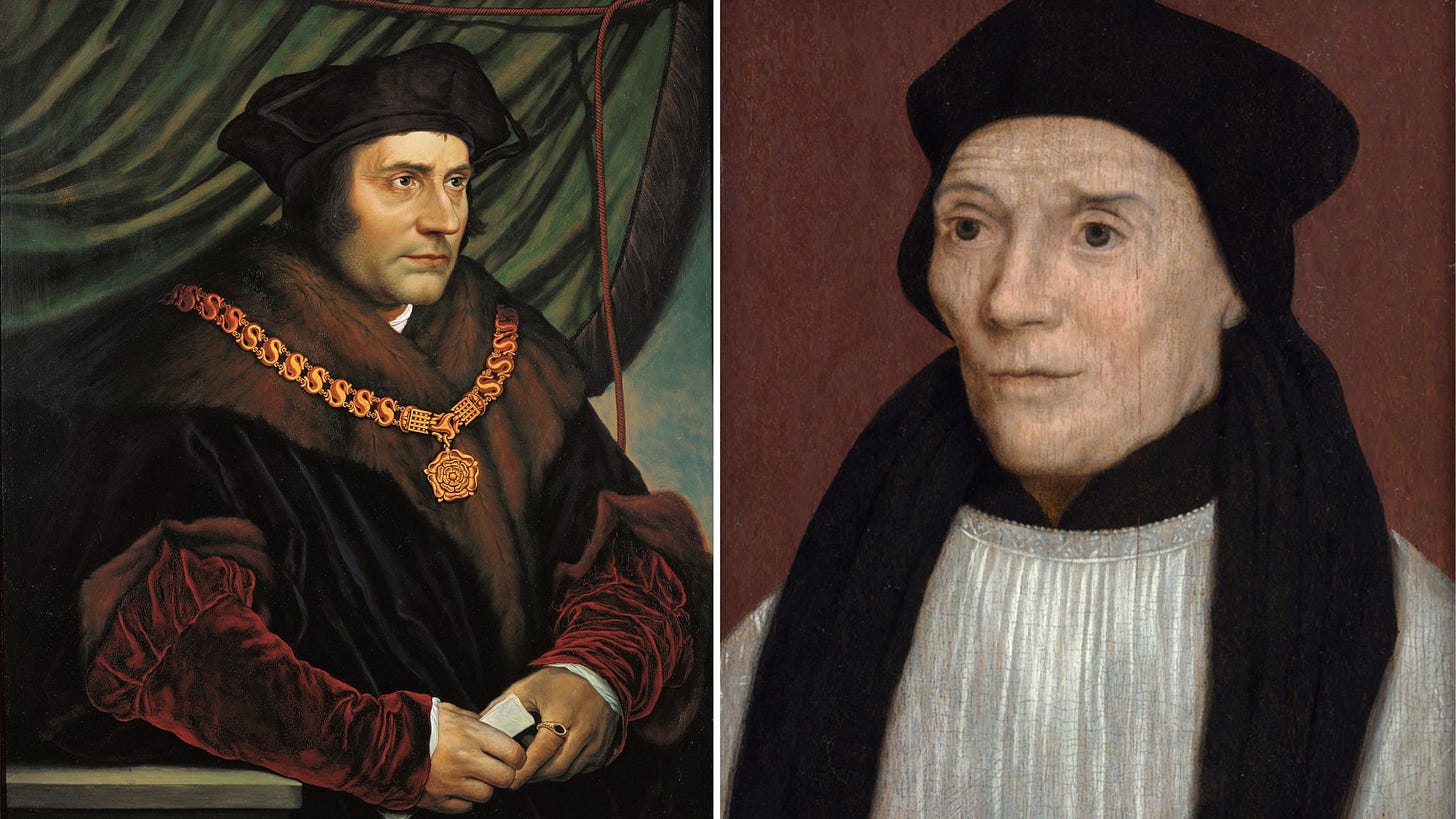
Who were Sts John Fisher and Thomas More? | Catholic Truth Society
On May 19, 1935, Pope Pius XI canonized Sir Thomas More and Cardinal John Fisher. King Henry VIII ordered the two men executed in 1535 for refusing to accept him as head of the Church of England.

Ss. Thomas More and John Fisher are now the patron saints of the Diocese of Rochester, N.Y. Cardinal Fisher was the Bishop of Rochester in England. He was the only Bishop not to give in to Henry. And More represented what a Catholic politician should do.


I will continue such Catholic posts. I want to try to promote the faith and not get caught up in pointless debates. 

Pax et bonum

Tuesday, May 12, 2026

Limericks to Share


There once was a young man from Gates,
whose skateboarding tempted the fates.
He tried a new trick,
but landed on brick -
now six months of rehab awaits.

A sweet-toothed baker named Sue
paused to decide what to do.
She sampled, you see,
a spoonful, or three,
and now all the frosting is through.

There was a young lady from Old Miss,
whose favorite pastime was to kiss.
She kissed Tom, Dick, and Harry,
Moe, Shemp, Curly, and Larry,
that puckering miss from Old Miss.

There was a young lady from Ealing
who put on a dress too revealing.
There were 14 sprained necks
and two auto wrecks
when she walked down the main street of Ealing.

The thing that startled Miss Cryder,
was not the mortician beside her.
It’s when she beheld,
the pan that now held
the insides no longer inside her.

A mad doc from South Aldersgate,
when asked why he never does date,
said, "Dating's a pain,
and so I'll refrain.
Besides, I can make my own mate.”

There was a young man from Belaire
whose head was deficient in hair.
He tried ev’ry lotion
and nostrum and potion,
but none could cut down on the glare

There is a young lady in Kuhn
who simply can’t carry a tune.
When she starts to sing,
the birds all take wing,
except for a tone-deaf old loon.

Community players most brave,
a performance of "Tempest" once gave.
Said a wit, "Now let's see
if it's Bacon or he -
that is, Shakespeare - who's turned in his grave.

An earnest young preacher named Breven
droned on about deadly sins seven.
Although he meant well,
his style was pure hell,
and drove many a lost soul from heaven.

There was an old lady from Greece
who signed a 90-year lease.
She hoped death would pause,
when he read the clause
that gave no release from the lease.

A young man once went off to college
intent on gaining some knowledge.
He learned lots they say,
about new ways to play
and that’s how he flunked out of college.

The orating mayor of Fort Bragg,
died when he crashed in his Jag.
Some wits noted later,
he met his creator
thanks to a faulty air bag.

At Halloween, ghosts misbehave.
They howl and shriek. They rant and rave.
They pop into view;
do nasty things, too.
So be warned - and get off my grave.

A bellowing bowser named Bruno
had a master who moved up to Juneau.
Now Bruno liked trees,
but in Juneau things freeze,
so Bruno’s now barking soprano.

At the apple fest I took a peek
at cars displayed there for the week.
I soon grew dismayed
to learn that cars made
my birth year are now called antique.

The truth about Orville Van Vleck
was revealed soon after the wreck.
His bride of one year
discovered her dear
left two other widows Van Vleck.

There once was a man with a wife
whose moods were the bane of his life.
When he did her in,
he said, with a grin,
“Divorce causes much too much strife.”

There was an old man with a wife
whose moods were a source of great strife.
At his murder trial,
he said, with a smile,
“Paroled from that sentence of life.”

There is an old lady from Gates,
Who keeps talking `bout what she hates.
Children, the weather,
The French, whatever –
No wonder she’s had seven mates.

Pax et bonum

Saturday, May 9, 2026

Next up ...


I performed for the first time in decades in a coffee house concert back om March 31. My set consisted of :

"I’m Gonna Live ‘til the Day I Die" (original)
"Bottle of Wine" (Tom Paxton)
"Tie Me Kangaroo Down Sport" (Rolf Harris)
"I Am Going Home" (original)
"Oh, Sinner Man" (traditional)
"There’s a Great Big Monster Under My Bed" (original)
"Walking Down the Line" (Bob Dylan)
"Get Up and Go" (Pete Seeger)

I've been thinking of doing more. This Tuesday the local folk society has a sing around at which everyone does a song or two, I've been practicing some songs, two of which I'm considering: "Never Ending Song of Love" (Delaney and Bonnie Bramlett), and an original I've been working on, "Lilacs in Season". The "Lilacs" song is fitting as our city hosts a Lilac Festival every year, and we are currently in the midst of it.

I've been practicing a few other songs that might be added to a future set.

"Well May the World Go" (Pete Seeger)
"Helpless" (Neil Young)
"Morning Has Broken" (Eleanor Farjeon)
"How Can I Keep From Singing (traditional)
"There's a Place in the World for a Gambler" (Dan Fogelberg)
"Lonely People" (America)
"I Shall Be Released" (Bob Dylan)

The first group and these new songs would give me more than an hour's set. I've been practicing more and more, so my voice - and my fingers - can hold up.

Do I see myself playing out a couple of times a week or at bars/brew houses? No. And to make money? No. More likely, occasional coffee house settings or open mic nights will be my limit.

Which is fine by me. I just enjoy it.

Pax et bonum

Monday, May 4, 2026

I Am Third


At Mass this morning the priest in his homily mentioned a gift he received when he was first ordained.

An elderly woman had cross-stitched a small rectangle with the words "I AM THIRD". He asked her what she meant, and she explained that for a Christian God comes first, other people come second, and the person comes third. He noted that the theology she expressed was more profound than anything he could articulate, and it's a message he's tried to keep in mind in his priestly ministry.

That part of his homily has stuck with me all day.

As a dad and husband, the message made sense to me. I would always make sure my family's needs were met first. I would make sure they were served first at meals, for example. I would buy new shoes or clothing for my children before I would buy any for myself. I always tried to think of ways to make life easier for my wife, even if it meant sacrificing in some ways on my part. When watching television, for example, I might have wanted to watch a baseball game, but if there was something on she wanted to watch, we'd watch what she wanted and I wouldn't say anything. I once even turned down a good-paying job that would have taken me away for extended periods of time and kept me from being there for my children's school events, Scouts, and so on. Family came first.  

But Father was right: The elderly woman's message was theologically more profound than just being a good dad.

God has to come first. Above job. Above sports. Above sleeping in on Sundays. Above ambition and compromising. 

Then other people - family, but others as well - come next. 

I've always tried to live that way but have failed at times. The homily was a good reminder.

Pax et bonum

Wednesday, April 22, 2026

Mysteries


I am a fan of mysteries and police procedurals, but with certain caveats.

I don't like mysteries with graphic violence, sex and immorality, excessive foul language, and pervasive cynicism. And I find the "Hallmark" kind of mysteries aimed at women to be kind of boring. 

I prefer the old-fashioned mysteries, and what is sometimes called cosies. 

Part of the attraction for me is that in a world tainted by evil the best mysteries have good defeating some of that evil. There is a sense of justice, and in some of the good ones (like the Father Brown ones or those of Fiorella De Maria), of possible repentance. 

One of my quibbles with some of the Agatha Christie ones is that the killer is given a chance to commit suicide. Perhaps in a British mind that is viewed as an "honorable" way of bringing about justice, but I find it unsatisfying.

And there are mysteries where the plots repeat some of the same elements - like when the protagonists keep repeating the same mistakes, as if they never learn or grow.  

I like the Father Brown mysteries, Dorothy Sayers' mysteries, some of Agatha Christie's novels. I also like the Navajo mysteries of Tony Hillerman. I have enjoyed the Father Gabriel mysteries of Fiorella De Maria.

One problem for me is that I've read all of the Father Browns, all of the Sayers, all of the Hillermans, all the De Maria. 

Yeah, when I find a writer I like I tend to read everything by that writer that I can find.

While I have mentioned some of the writers whose works I like, there is one book by another author that I really liked: The Daughter of Time by Josephine Tey (Elizabeth MacKintosh). It deals with a contemporary investigator exploring the alleged killing of the Princes by King Richard III. It's an intelligent, well-crafted book.

So, who do I read now?

I'd like to read more of Ellis Peters' Brother Cadfael mysteries. I'll have to scour the local libraries to find more. De Maria is still young, so there will hopefully be more Father Gabriel books to come. And there are many Christie's I have not yet read.

Out of curiosity, I looked back over my lists of books read in the past six years - post retirement - to see who I have read. I discovered 82 titles!

Meanwhile, here's a mostly complete list of mysteries/police procedurals I've read since 2020.

The Scandal of Father Brown by G. K. Chesterton

The Secret of Father Brown by G.K. Chesterton

“The Donnington Affair” by G. K. Chesterton

“The Vampire of the Village” by G. K. Chesterton

The Incredulity of Father Brown by G. K. Chesterton

The Innocence of Father Brown by G. K, Chesterton


Trent’s Last Case by E. C. Bentley

The Daughter of Time by Josephine Tey (Elizabeth MacKintosh)

The Moonstone by Wilkie Collins


Missing, Presumed Lost by Fiorella De Maria

May Day!  by Fiorella De Maria 

The Vanishing Woman by Fiorella De Maria

See No Evil by Fiorella De Maria

Death of a Scholar by Fiorella De Maria

The Sleeping Witness by Fiorella De Maria


The Unpleasantness at the Bellona Club by Dorothy Sayers  

Have His Carcase by Dorothy Sayers

Gaudy Night by Dorothy L. Sayers

Strong Poison by Dorothy L. Sayers

Busman’s Honeymoon by Dorothy L. Sayers

The Five Red Herrings by Dorothy Sayers

Murder Must Advertise by Dorothy Sayers

The Nine Tailors by Dorothy Sayers

Whose Body? by Dorothy L. Sayers

Clouds of Witness by Dorothy L. Sayers

Talking God by Tony Hillerman

Coyote Waits by Tony Hillerman

Sacred Clowns by Tony Hillerman

A Thief of Time  by Tony Hillerman

People of Darkness by Tony Hillerman

The Ghostway by Tony Hillerman

Skinwalkers by Tony Hillerman

The Dark Wind by Tony Hillerman

Listening Woman by Tony Hillerman

The Dance Hall of the Dead by Tony Hillerman

The Blessing Way by Tony Hillerman

The Shape Shifter by Tony Hillerman

Skeleton Man by Tony Hillerman

The Sinister Pig by Tony Hillerman

The Wailing Wind  by Tony Hillerman

Hunting Badger by Tony Hillerman

The First Eagle by Tony Hillerman


Curtain by Agatha Christie

And Then There Were None by Agatha Christie

Murder on the Orient Express by Agatha Christie

Sleeping Murder by Agatha Christie

A Murder is Announced by Agatha Christie

The A.B.C. Murders by Agatha Christie

The Murder at the Vicarage by Agatha Christie

Death on the Nile by Agatha Christie

The Murder of Roger Ackroyd by Agatha Christie


The Holy Thief by Ellis Peters

Dead Man’s Ransom by Ellis Peters

An Excellent Mystery by Ellis Peters


The Valley of Fear by Arthur Conan Doyle

The Sign of Four by Arthur Conan Doyle

A Study in Scarlet by Arthur Conan Doyle


Rough Cider by Peter Lovesey

The Thin Man by Dashiell Hammett

The Maltese Falcon by Dashiell Hammett

In the Woods by Tana French

All the Dead Heroes by Stephen F. Wilcox

A Red Herring Without Mustard by Alan Bradley

The Sweetness at the Bottom of the Pie by Alan Bradley

The Clue of the Whistling Bagpipes by “Carolyn Keene”

Maigret on the Defensive by Georges Simenon


Twice Buried by Steven Havill

Out of Season by Steven Havill

Before She Dies by Steven F. Havill

Murder in the Lincoln White House by C. M. Gleason

Murder at the Capitol by C. M. Gleason


Winter’s Child by Margaret Coel
Killing Custer by Margaret Coel
The Spirit Woman by Margaret Coel

Advent of Dying by Sister Carol Anne O’Marie

Requiem at the Refuge by Sister Carol Anne O’Marie

Sine Qua Nun by Monica Quill (Ralph M. McInerny)

Last Things by Ralph McInerny


Thistles and Thieves by Molly MacRae

The Cracked Spine by Paige Shelton

The Loch Ness Papers by Paige Shelton


Pax et bonum