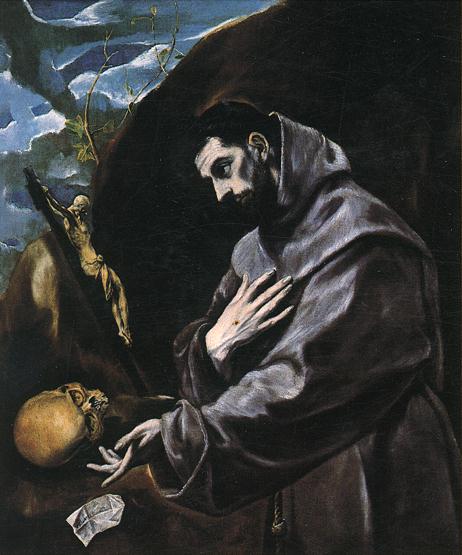
(from The Little Flowers of St. Francis)
HOW ST FRANCIS PASSED THE TIME OF LENT IN AN ISLAND, ON THE LAKE OF PERUGIA, WHERE HE FASTED FORTY DAYS AND FORTY NIGHTS, EATING NO MORE THAN HALF OF ONE LOAF
The true servant of Christ, St Francis, was in certain things like unto a second Christ given to the world for the salvation of souls. Wherefore God the Father willed that in many points he should be conformed to his Son, Jesus Christ, as we have already explained in the calling of his twelve companions, as also in the mystery of the holy stigmata, and in a fast of forty days which he made in the manner following:St Francis, one day of the Carnival, was near the Lake of Perugia, in the house of one of his devout children, with whom he had spent the night, when he was inspired by God to go and pass the time of Lent in an island on the lake. Wherefore St Francis begged his friend, for the love of God, to convey him in his boat to an island uninhabited by man: the which he should do during the night of Ash-Wednesday, so that none might know where he was; and the friend, because of the great devotion he bore to St Francis, agreed to his request, and conveyed him to the said island, St Francis taking with him naught but two small loaves.
When they had reached the island, his friend left him and returned home; the saint earnestly entreating him to reveal to no one where he was, and not to come and fetch him before Holy Thursday; to which he consented.St Francis being left alone, and there being no dwelling in the island in which he could take shelter, entered into a thick part of the wood all overgrown with brambles and other creeping plants, and forming as it were a kind of hut, there he began to pray and enter into the contemplation of divine things. And there he passed the whole of Lent without drinking or eating save half of one of the small loaves he had taken with him, as we learned from his friend who, going to fetch him on Holy Thursday, found one of the loaves untouched and the other only half consumed. It is believed that St Francis ate this half out of reverence for our Blessed Lord, who fasted forty days and forty nights without taking any material food; for by eating this bit of bread he put aside the temptation to vainglory, and yet fasted forty days and forty nights in imitation of the Saviour. In later times God worked many miracles, through the merits of the saint, on the spot where St Francis had fasted so wonderfully, on which account people began to build houses and dwell there, and little by little a town rose up, with a convent called the Convent of the Isle; and to this day the inhabitants of that town hold in great respect and great devotion the spot in which St Francis passed the time of Lent.
(What an example: To eat a little just to avoid vainglory. How often I feel compelled to call attention to myself for lesser deeds.)
Pax et bonum
HOW ST FRANCIS PASSED THE TIME OF LENT IN AN ISLAND, ON THE LAKE OF PERUGIA, WHERE HE FASTED FORTY DAYS AND FORTY NIGHTS, EATING NO MORE THAN HALF OF ONE LOAF
The true servant of Christ, St Francis, was in certain things like unto a second Christ given to the world for the salvation of souls. Wherefore God the Father willed that in many points he should be conformed to his Son, Jesus Christ, as we have already explained in the calling of his twelve companions, as also in the mystery of the holy stigmata, and in a fast of forty days which he made in the manner following:St Francis, one day of the Carnival, was near the Lake of Perugia, in the house of one of his devout children, with whom he had spent the night, when he was inspired by God to go and pass the time of Lent in an island on the lake. Wherefore St Francis begged his friend, for the love of God, to convey him in his boat to an island uninhabited by man: the which he should do during the night of Ash-Wednesday, so that none might know where he was; and the friend, because of the great devotion he bore to St Francis, agreed to his request, and conveyed him to the said island, St Francis taking with him naught but two small loaves.
When they had reached the island, his friend left him and returned home; the saint earnestly entreating him to reveal to no one where he was, and not to come and fetch him before Holy Thursday; to which he consented.St Francis being left alone, and there being no dwelling in the island in which he could take shelter, entered into a thick part of the wood all overgrown with brambles and other creeping plants, and forming as it were a kind of hut, there he began to pray and enter into the contemplation of divine things. And there he passed the whole of Lent without drinking or eating save half of one of the small loaves he had taken with him, as we learned from his friend who, going to fetch him on Holy Thursday, found one of the loaves untouched and the other only half consumed. It is believed that St Francis ate this half out of reverence for our Blessed Lord, who fasted forty days and forty nights without taking any material food; for by eating this bit of bread he put aside the temptation to vainglory, and yet fasted forty days and forty nights in imitation of the Saviour. In later times God worked many miracles, through the merits of the saint, on the spot where St Francis had fasted so wonderfully, on which account people began to build houses and dwell there, and little by little a town rose up, with a convent called the Convent of the Isle; and to this day the inhabitants of that town hold in great respect and great devotion the spot in which St Francis passed the time of Lent.
(What an example: To eat a little just to avoid vainglory. How often I feel compelled to call attention to myself for lesser deeds.)
Pax et bonum
