Tuesday, August 23, 2022

ANCESTRY! #$#$@%#


Ancestry has updated my results again -

Ireland 42% 
England & Northwestern Europe 35%
Scotland 16%
Sweden & Denmark 7%

It had updated just this past April.

Ireland 39%
England & Northwestern Europe 29%
Scotland 28%
Sweden & Denmark 4%

So now more Irish, English/Western Europe, and Sweden/Denmark, less Scottish. And overall less Celtic. 

They have updated multiple times as they have gotten more people in their data base -

September 2021

Scotland - 57%
Ireland - 33% (with ties to Donegal)
England and Northwestern Europe - 10%.

2020 -

Scotland - 54%
Ireland (with strong links to Donegal) - 29%
England and Northwestern Europe - 13%
Wales - 3%
Norway - 1%

2018 -

Ireland/Scotland/Wales - 58 %.
Great Britain - 36 %.
Scandinavia is now Sweden, and dropped to just 4 %.
Germanic Europe - 2 %.

2014

Ireland - 56 %
Scandinavia - 16 %
Great Britain - 10 %
Iberian Peninsula - 8 %
Western Europe - 5 %
A few odd traces - 3 %

Frustrating and confusing. 

Thursday, August 18, 2022

Saint Louis of Toulouse


When he died at the age of 23, Louis was already a Franciscan, a bishop, and a saint!

Louis’s parents were Charles II of Naples and Sicily, and Mary, daughter of the King of Hungary. Louis was related to Saint Louis IX on his father’s side and to Elizabeth of Hungary on his mother’s side.

Louis showed early signs of attachment to prayer and to the corporal works of mercy. As a child he used to take food from the castle to feed the poor. When he was 14, Louis and two of his brothers were taken as hostages to the king of Aragon’s court as part of a political deal involving Louis’s father. At the court, Louis was tutored by Franciscan friars under whom he made great progress both in his studies and in the spiritual life. Like Saint Francis he developed a special love for those afflicted with leprosy.

While he was still a hostage, Louis decided to renounce his royal title and become a priest. When he was 20, he was allowed to leave the king of Aragon’s court. He renounced his title in favor of his brother Robert and was ordained the next year. Very shortly after, he was appointed bishop of Toulouse, but the pope agreed to Louis’s request to become a Franciscan first.

The Franciscan spirit pervaded Louis. “Jesus Christ is all my riches; he alone is sufficient for me,” Louis kept repeating. Even as a bishop he wore the Franciscan habit and sometimes begged. He assigned a friar to offer him correction—in public if necessary—and the friar did his job.

Louis’s service to the Diocese of Toulouse was richly blessed. In no time he was considered a saint. Louis set aside 75 percent of his income as bishop to feed the poor and maintain churches. Each day he fed 25 poor people at his table.

Louis was canonized in 1317 by Pope John XXII, one of his former teachers. His liturgical feast is celebrated on August 19.

- From Franciscan Media

Pax et bonum

Sunday, August 14, 2022

Saint Maximilian Mary Kolbe


“I don’t know what’s going to become of you!” How many parents have said that? Maximilian Mary Kolbe’s reaction was, “I prayed very hard to Our Lady to tell me what would happen to me. She appeared, holding in her hands two crowns, one white, one red. She asked if I would like to have them—one was for purity, the other for martyrdom. I said, ‘I choose both.’ She smiled and disappeared.” After that he was not the same.


He entered the minor seminary of the Conventual Franciscans in Lvív--then Poland, now Ukraine-- near his birthplace, and at 16 became a novice. Though Maximilian later achieved doctorates in philosophy and theology, he was deeply interested in science, even drawing plans for rocket ships.

Ordained at 24, Maximilian saw religious indifference as the deadliest poison of the day. His mission was to combat it. He had already founded the Militia of the Immaculata, whose aim was to fight evil with the witness of the good life, prayer, work, and suffering. He dreamed of and then founded Knight of the Immaculata, a religious magazine under Mary’s protection to preach the Good News to all nations. For the work of publication he established a “City of the Immaculata”—Niepokalanow—which housed 700 of his Franciscan brothers. He later founded another one in Nagasaki, Japan. Both the Militia and the magazine ultimately reached the one-million mark in members and subscribers. His love of God was daily filtered through devotion to Mary.

In 1939, the Nazi panzers overran Poland with deadly speed. Niepokalanow was severely bombed. Kolbe and his friars were arrested, then released in less than three months, on the feast of the Immaculate Conception.

In 1941, Fr. Kolbe was arrested again. The Nazis’ purpose was to liquidate the select ones, the leaders. The end came quickly, three months later in Auschwitz, after terrible beatings and humiliations.

A prisoner had escaped. The commandant announced that 10 men would die. He relished walking along the ranks. “This one. That one.”

As they were being marched away to the starvation bunkers, Number 16670 dared to step from the line.

“I would like to take that man’s place. He has a wife and children.”
“Who are you?”
“A priest.”

No name, no mention of fame. Silence. The commandant, dumbfounded, perhaps with a fleeting thought of history, kicked Sergeant Francis Gajowniczek out of line and ordered Fr. Kolbe to go with the nine. In the “block of death” they were ordered to strip naked, and their slow starvation began in darkness. But there was no screaming—the prisoners sang. By the eve of the Assumption, four were left alive. The jailer came to finish Kolbe off as he sat in a corner praying. He lifted his fleshless arm to receive the bite of the hypodermic needle. It was filled with carbolic acid. They burned his body with all the others. Fr. Kolbe was beatified in 1971 and canonized in 1982.


- From Franciscan Media
Pax et bonum

Saint Clare Clerihew


There's a legend that St. Clare appeared at the '36 World Fair,. Some folks at the television display claimed they did see on the screen the face of the fair saint from Assisi.

Pax et bonum

Friday, August 12, 2022

The Two Noble Kinsmen


In my quest to read all of Shakespeare's officially credited plays, I ran into a problem.

One of those plays, The Two Noble Kinsmen, was not readily available as a stand-alone play, and it was not in the "complete" Shakespeare volume I've had since college days. 

Part of the problem is that he apparently wrote it with John Fletcher, and there was a dispute among scholars whether is should properly be called a play by Shakespeare. It is now accepted as a "Shakespeare" play with dual authorship, and is included in later collections.

So much for going to college in the 1970s!

I managed to find a collection that had the play in it. As I read, I kept thinking some of it sounded familiar, so I checked the notes. Aha! Based on Chaucer's "The Knight's Tale." Shakespeare regularly based his plays on sources, so no surprise.

As a play/story, it was okay. The main characters acted in keeping with traditional patterns for such characters. There were some interesting patches of dialogue. Some of the long speeches - giving the main actors their moment on stage? - did seem a bit much after a while. The side story of the Jailer' s Daughter and her madness bugged me, though. The treatment advised by the doctor was to have a man who wanted to woo her anyway pretend to be the man she loved (and because of whom she went crazy) and to do anything she wanted, including have sex. Apparently the cure works, but by modern standards, sex with a delusional, mentally unstable person in this way would be rape. Ugh.

I now have two more plays to read to complete my goal - Measure for Measure and Coriolanus.

There are a couple of other plays that scholar now think had some input from Shakespeare - The Book of Sir Thomas More and Cardenio. The former was a collaborative play with a number of writers (including Shakespeare) contributing lines/scenes/revisions to the original text of the play. The latter was apparently a collaboration of Shakespeare and Fletcher, though the versions we have were from later writers based on that original. I'll probably read both at some point - particularly the More one due to my admiration of Saint Thomas More - but they are not part of the official list.

Pax et bonum

Saint Clare


One of the more sugary movies made about Francis of Assisi pictures Clare as a golden-haired beauty floating through sun-drenched fields, a sort of one-woman counterpart to the new Franciscan Order.

The beginning of her religious life was indeed movie material. Having refused to marry at 15, Clare was moved by the dynamic preaching of Francis. He became her lifelong friend and spiritual guide.

At 18, Clare escaped from her father’s home one night, was met on the road by friars carrying torches, and in the poor little chapel called the Portiuncula received a rough woolen habit, exchanged her jeweled belt for a common rope with knots in it, and sacrificed her long tresses to Francis’ scissors. He placed her in a Benedictine convent, which her father and uncles immediately stormed in rage. Clare clung to the altar of the church, threw aside her veil to show her cropped hair, and remained adamant.

Sixteen days later her sister Agnes joined her. Others came. They lived a simple life of great poverty, austerity, and complete seclusion from the world, according to a Rule which Francis gave them as a Second Order. At age 21, Francis obliged Clare under obedience to accept the office of abbess, one she exercised until her death.

The Poor Ladies went barefoot, slept on the ground, ate no meat, and observed almost complete silence. Later Clare, like Francis, persuaded her sisters to moderate this rigor: “Our bodies are not made of brass.” The greatest emphasis, of course, was on gospel poverty. They possessed no property, even in common, subsisting on daily contributions. When even the pope tried to persuade Clare to mitigate this practice, she showed her characteristic firmness: “I need to be absolved from my sins, but I do not wish to be absolved from the obligation of following Jesus Christ.”

Contemporary accounts glow with admiration of Clare's life in the convent of San Damiano in Assisi. She served the sick and washed the feet of the begging nuns. She came from prayer, it was said, with her face so shining it dazzled those about her. She suffered serious illness for the last 27 years of her life. Her influence was such that popes, cardinals, and bishops often came to consult her—Clare herself never left the walls of San Damiano.

Francis always remained her great friend and inspiration. Clare was always obedient to his will and to the great ideal of gospel life which he was making real.

A well-known story concerns her prayer and trust. Clare had the Blessed Sacrament placed on the walls of the convent when it faced attack by invading Saracens. “Does it please you, O God, to deliver into the hands of these beasts the defenseless children I have nourished with your love? I beseech you, dear Lord, protect these whom I am now unable to protect.” To her sisters she said, “Don’t be afraid. Trust in Jesus.” The Saracens fled.

Pax et bonum

Wednesday, August 3, 2022

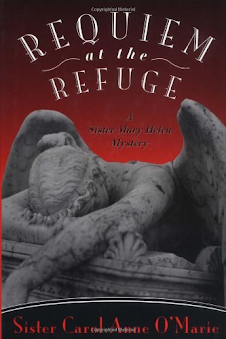
Requiem at the Refuge by Sister Carol Anne O'Marie


Our parish has a rummage sale room. People donate all sort of items - dishes, decorations, statues, etc - and other people buy these items, making a free-will offering.

Among the items for sale are books. I was looking at the shelves when I spotted a mystery book, Requiem at the Refuge by Sister Carol Anne O’Marie. 

I had never heard of Sister O'Marie, but noted on the cover that she had written a series of mysteries with an elderly religious sister as the detective. I later discovered the late Sister had written 11 such mysteries between 1984 and 2006. This particular one was from 2000.

I made a donation and took the book home.

As a mystery, the book was good - not great, but certainly enjoyable and well-written. The characters were interesting, and the story held my attention. And I liked the fact that faith plays a role in the story.

I couldn't help comparing it to another religious sister mystery I had recently read, Sine Qua Nun by Monica Quill (Ralph M. McInerny). McInerny has a tendency to insert his grumbles about the Church into his mystery books. Sister O'Marie's characters are clearly faithful, but the faith is part of who they are, and not an excuse to preach. I prefer that approach. 

 Would I read another book by Sister O'Marie? Yes, though I don't feel the need to go out immediately and seek more of her books. This particular one was a discard from our local library, and when I looked in the library's online catalog I saw there were no other books by her listed, though there are several listed in our regional library system catalog. I'm glad to know she's still popular enough that people are reading her. 

Pax et bonum