Sunday, May 24, 2026

Checkmate


When I was a boy, my father taught me how to play chess. We played fairly regularly, once or twice a week. He almost always beat me at first. But the more we played, the more I started to win. Eventually, I beat him almost every time. He started complaining that the pieces were too small, the lighting was poor, or he was busy, and, well, we stopped playing.

By that point I was in middle school. I played with a few school friends, then I heard about a county chess tournament with a youth division. I registered for it.

I won a couple of games, then got crushed in one against a high school student. But I still ended up taking 6th!

In high school I helped to found a chess club, becoming the president. I pretty consistently beat everyone, including a friend who was the vice president. By senior year he was obviously growing increasingly frustrated whenever we played and as I consistently won. At the same time, I was getting involved with other interests, including being on a couple of sports teams, dating, and writing. So, my chess playing outside the club decreased.

My freshman year of college I barely played chess. My friend went to a college out of state, and he wrote occasionally. He mentioned that he found some folks to play chess with there and he looked forward to playing me again when he got back for the summer. He also mentioned that he had taken one of my poems, submitted it for a class assignment claiming he had written it, and got a good grade. He thought I'd be pleased that the poem had gotten a good grade. I wasn't.

Summer arrived and my friend came back. We met, talked about our college experiences, and played a game of chess.  He soundly defeated me. He was ecstatic. He said that he had spent the year studying chess books just to get ready to face me again.

It was kind of weird, and troubling. He'd spent a year obsessed about beating me at a board game?

That was about the last time that I saw him. We didn't avoid each other, but we certainly didn't seek each other out. I haven't seen him in years. 

The incident got me to thinking. Once an avid chess player, I had slacked off because life had intervened. But also, I had realized that I had reached a certain level of proficiency, and if I wanted to get better, I would really have to dedicate myself to practicing and studying chess. I'd have to give up some of my other activities. For a board game?

Plus, to be honest, I was not certain I really could rise to the top levels. I was good, but not that good.  

I'd had a similar experience with the one sport I was good in, bowling. I had risen to the level of a being a good high school bowler - winning in several leagues and becoming a member to the school's team, even earning a letter - but if I wanted to get really good, I knew I would have to bowl a lot more. That would have more cost more money than I had - I was paying my own way through college. Bowling became another thing I decided was less important. 

Years later, I encountered another game with which I had some skill: Scrabble. 

I played socially and soon found myself seeking out games with good players. We even held what we called "cutthroat" games to which only certain skilled players were invited to play. Then our city hosted a Scrabble tournament. Players were coming in from all over the Northeast, and even Canada. I registered.

The first day, I won every game I played, including defeating one of Canada's top players! I also won an award for the single highest score on one play. 

I was invited back the second day for the championship rounds. I lost both games I played. Sigh.

In talking with some of the other players, ones who competed in tournaments and for cash, they all talked about all the hours of studying and practicing that they did. They were obsessively dedicated. I realized that while I enjoyed the game, there were other things I needed to focus on: My marriage, my children, my church, my career, my writing. 

I haven't competed in a Scrabble tournament since. Oh, I still play, just like I occasionally play chess. But I have more important things in my life.  

I suppose what I realized is what would have been true of me is true of so many other people who rise to the top levels in such activities as sports and games. Yes, some are able to balance their lives, God bless them, but there are many who did not succeed is doing so. How many of them are so dedicated to the activity they are emotionally, mentally, or spiritual stunted? How many of them find that when age finally limits their abilities they have little to fall back on? How many of them faced years of mental illness, broken relationships and marriages, addiction, criminal activities, bankruptcy, and so on. Think of Bobby Fischer, Junior Seau, Todd Marinovich, and more.  

Are games really that important?

As for me, I just hope someday I'll be able to play the word "checkmate" in Scrabble. That should be worth a few points!

Pax et bonum

Saturday, May 23, 2026

May 23 in Catholic History: Joan of Arc


On May 23, 1430, St. Joan of Arc led an attempt to repel attackers at Compiegne and was captured by the Burgundians. The Burgundians then sold her to the English. 

St. Joan had earned English enmity after leading French forces to victory in a series of battles. Guided by visions, St. Joan had in 1428 gone to the future King Charles VII to help him save France from English domination and control. She inspired French forces at Orleans, forcing the English to abandon the city, and then led French forces during the Loire Campaign. Under her, the French won at Patay, permitting French forces to take Reims. There, Charles was crowned as King.

In 1430, Compiegne was under siege, and St. Joan went there to help, leading to her being surrounded and captured.

Pax et bonum

Friday, May 22, 2026

May 22 in Catholic History: The Council of Trent


On May 22, 1545, Pope Paul III issued a call for a what became the Council of Trent. He invited both the Catholic Bishops and Protestant leaders of the Reformation to gather in Trent, Italy to try to peacefully resolve their differences. The Protestants refused. The Council went on nevertheless, with multiple sessions between 1545 and 1563.

The Council dealt with a variety of issues, including some over which the Protestants disagreed with the Church, such as indulgences, justification, and veneration of the saints. The Council also discussed original sin, the seven sacraments, the Eucharist, penance, extreme unction, and episcopal discipline, reformed the Mass, standardized liturgical practices, and much more.

The Council clarified Catholic doctrine in opposition to Protestant teachings.

Both Scripture and Tradition were affirmed as sources of divine revelation, rejecting sola scriptura.

Salvation requires both faith and works, countering the Protestant doctrine of sola fide.

All seven sacraments were reaffirmed as instituted by Christ.

The doctrine of transubstantiation and the Real Presence of Christ were upheld.

The Latin Vulgate was declared authoritative, including the deuterocanonical books.


Pax et bonum

Thursday, May 21, 2026

A To-do About IQ


I came across an article discussing and ranking the estimated IQs of Presidents of the United States. Curious about whether any studies had actually been done of their IQs I checked a few other articles about that subject. I found some variations about the listings and assessments, but some consistency as well.

As I looked, I thought back to some tests I had taken in my teens and 20s. Those tests consistently estimated my IQ as between 120 and 129. That puts me in the above average range. That makes sense. I've generally been among the most intelligent persons in any group or situation, but there are often a few people who are more intelligent. Those more gifted individuals would be considered gifted (130-144), exceptionally gifted (145-159), or profoundly gifted (160+).

I then wondered where I would rank in comparison with the Presidents. Certainly, Presidents would have to have a certain level of intellectual ability - or perhaps luck or just plain ambition - to have risen that high.  

As I noted, there are some variations in the assessments/rankings based on the different criteria used. The consensus seems to be that the President with the highest IQ was John Quincy Adams, whose IQ is estimated between 168 and 175.

Wow.

The President most often listed as second on the list is Thomas Jefferson with an IQ around 160.

In one list John Kennedy is ranked 3rd (around 160 also), followed by Bill Clinton (159) and Jimmy Carter (157). In another list Woodrow Wilson is tied with Clinton, pushing Jimmy Cater to 6th. 

Among those who made the rest of the top 10 - with variations depending on the lists - are James Madison, John Adams, Barack Obama, Teddy Roosevelts, Franklin Roosevelt, Millard Filmolre, William Howard Taft, and Abraham Lincoln. 

By the way, Donald Trump is generally ranked 15th or 16, with an estimated IQ of around 145. 

It turns out that my range is also the range of the lowest ranked Presidents. The only one who drops below that 120-129 range is Joe Biden at 115 - at the top end of the average range. 

In the 120s - again, there are variations depending on the lists - appear James Buchanan, Andrew Jackson, Zachary Taylor, Harry Truman, Calvin Coolidge, Andrew Johnson, Warren Harding, Ulysses S. Grant, Lyndon Johnson, and George W. Bush. 

Hmm. A mixed bag. Some are ranked among the worst Presidents too. 

So I had the IQ to be President - albeit one of the lowest ranked by that criterion. 

But I was smart enough not to try.  

Pax et bonum

May 21 in Catholic History: Father Damien


On May 21, 1864, Father Damien De Veuster was ordained in Hawaii. He is better known as St. Damien of Molokai.

Born in Belgium January 3, 1840, he had traveled to Hawai'i to be a missionary. In 1873, he volunteered to minister to the lepers at Molokai. He established a parish, built a church, and set about to improve condition in the colony. He built a reservoir, built homes and furniture, made coffins, and dug graves. He taught, painted houses, organized farms, took care of his parishioners' wounds, and identified and encouraged leaders in the community.

In 1884, he discovered he had contracted leprosy. He continued to serve the people of the colony until his death of the disease April 15, 1889.

Pax et bonum

Wednesday, May 20, 2026

Three Saturnes


First 
arrest
for the clone
repeats source's
crime.

The 
dragon
hungrily
watched as the knight 
neared.

Two 
robots
stood rusted
with batteries
dead.

Pax et bonum

May 20 in Catholic History - Nicaea


On May 20, 325, the First Council of Nicaea convened to address the Arian controversy over the nature of Jesus. The Council also considered such issues at the date of Easter, clerical celibacy, and Canon Law.

The Council was called by Roman Emperor Constnatine to help resolve church disputes peacefully. One of the attendees was St. Nicholas, Bishop of Myra, who, according to legend was less that was peaceful, slapping Arius, who contended the Jesus was a created being, and was distinct from God the Father.

The Council formulated the Nicene Creed which declared Jesus is consubstantial with the Father, not created by God and distinct from God. The Arian heresy did not go away immediately, however. Indeed, it lingers still in such denominations like Jehovah's Witnesses and some Churches of Christ.

The Council began the process of resolving some of the other disputes.

The alleged incident with St. Nicholas inspired one of my clerihews:

At Nicaea, St. Nicholas
slapped a naughty Arius.
Since then he's found a list does fine
to help keep those who stray in line.


Pax et bonum

Tuesday, May 19, 2026

Daily Posts


Over on some other sites I am posting almost daily, largely short pieces about Catholic history. For example, today I posted:

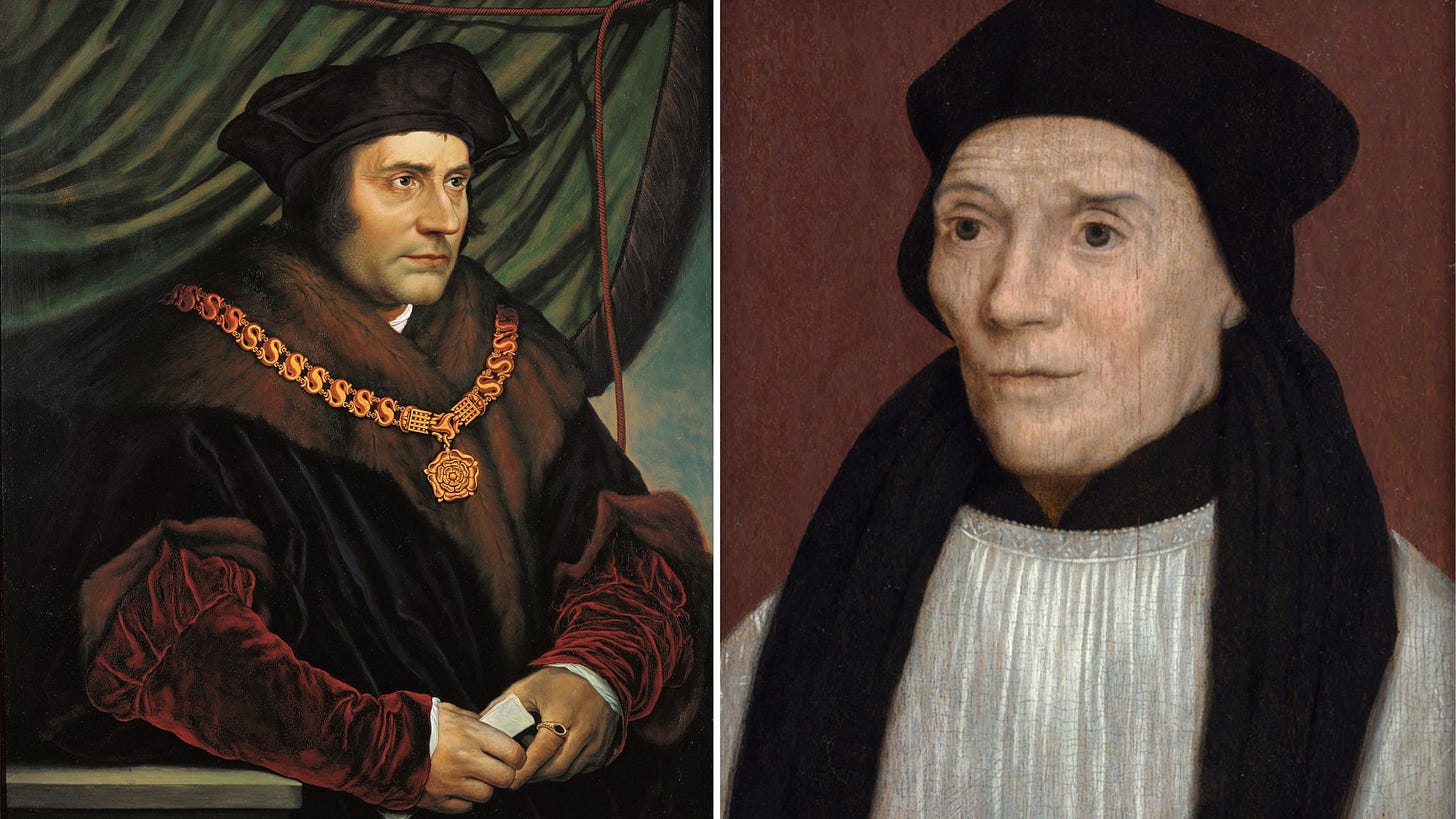
Who were Sts John Fisher and Thomas More? | Catholic Truth Society
On May 19, 1935, Pope Pius XI canonized Sir Thomas More and Cardinal John Fisher. King Henry VIII ordered the two men executed in 1535 for refusing to accept him as head of the Church of England.

Ss. Thomas More and John Fisher are now the patron saints of the Diocese of Rochester, N.Y. Cardinal Fisher was the Bishop of Rochester in England. He was the only Bishop not to give in to Henry. And More represented what a Catholic politician should do.


I will continue such Catholic posts. I want to try to promote the faith and not get caught up in pointless debates. 

Pax et bonum

Tuesday, May 12, 2026

Limericks to Share


There once was a young man from Gates,
whose skateboarding tempted the fates.
He tried a new trick,
but landed on brick -
now six months of rehab awaits.

A sweet-toothed baker named Sue
paused to decide what to do.
She sampled, you see,
a spoonful, or three,
and now all the frosting is through.

There was a young lady from Old Miss,
whose favorite pastime was to kiss.
She kissed Tom, Dick, and Harry,
Moe, Shemp, Curly, and Larry,
that puckering miss from Old Miss.

There was a young lady from Ealing
who put on a dress too revealing.
There were 14 sprained necks
and two auto wrecks
when she walked down the main street of Ealing.

The thing that startled Miss Cryder,
was not the mortician beside her.
It’s when she beheld,
the pan that now held
the insides no longer inside her.

A mad doc from South Aldersgate,
when asked why he never does date,
said, "Dating's a pain,
and so I'll refrain.
Besides, I can make my own mate.”

There was a young man from Belaire
whose head was deficient in hair.
He tried ev’ry lotion
and nostrum and potion,
but none could cut down on the glare

There is a young lady in Kuhn
who simply can’t carry a tune.
When she starts to sing,
the birds all take wing,
except for a tone-deaf old loon.

Community players most brave,
a performance of "Tempest" once gave.
Said a wit, "Now let's see
if it's Bacon or he -
that is, Shakespeare - who's turned in his grave.

An earnest young preacher named Breven
droned on about deadly sins seven.
Although he meant well,
his style was pure hell,
and drove many a lost soul from heaven.

There was an old lady from Greece
who signed a 90-year lease.
She hoped death would pause,
when he read the clause
that gave no release from the lease.

A young man once went off to college
intent on gaining some knowledge.
He learned lots they say,
about new ways to play
and that’s how he flunked out of college.

The orating mayor of Fort Bragg,
died when he crashed in his Jag.
Some wits noted later,
he met his creator
thanks to a faulty air bag.

At Halloween, ghosts misbehave.
They howl and shriek. They rant and rave.
They pop into view;
do nasty things, too.
So be warned - and get off my grave.

A bellowing bowser named Bruno
had a master who moved up to Juneau.
Now Bruno liked trees,
but in Juneau things freeze,
so Bruno’s now barking soprano.

At the apple fest I took a peek
at cars displayed there for the week.
I soon grew dismayed
to learn that cars made
my birth year are now called antique.

The truth about Orville Van Vleck
was revealed soon after the wreck.
His bride of one year
discovered her dear
left two other widows Van Vleck.

There once was a man with a wife
whose moods were the bane of his life.
When he did her in,
he said, with a grin,
“Divorce causes much too much strife.”

There was an old man with a wife
whose moods were a source of great strife.
At his murder trial,
he said, with a smile,
“Paroled from that sentence of life.”

There is an old lady from Gates,
Who keeps talking `bout what she hates.
Children, the weather,
The French, whatever –
No wonder she’s had seven mates.

Pax et bonum

Saturday, May 9, 2026

Next up ...


I performed for the first time in decades in a coffee house concert back om March 31. My set consisted of :

"I’m Gonna Live ‘til the Day I Die" (original)
"Bottle of Wine" (Tom Paxton)
"Tie Me Kangaroo Down Sport" (Rolf Harris)
"I Am Going Home" (original)
"Oh, Sinner Man" (traditional)
"There’s a Great Big Monster Under My Bed" (original)
"Walking Down the Line" (Bob Dylan)
"Get Up and Go" (Pete Seeger)

I've been thinking of doing more. This Tuesday the local folk society has a sing around at which everyone does a song or two, I've been practicing some songs, two of which I'm considering: "Never Ending Song of Love" (Delaney and Bonnie Bramlett), and an original I've been working on, "Lilacs in Season". The "Lilacs" song is fitting as our city hosts a Lilac Festival every year, and we are currently in the midst of it.

I've been practicing a few other songs that might be added to a future set.

"Well May the World Go" (Pete Seeger)
"Helpless" (Neil Young)
"Morning Has Broken" (Eleanor Farjeon)
"How Can I Keep From Singing (traditional)
"There's a Place in the World for a Gambler" (Dan Fogelberg)
"Lonely People" (America)
"I Shall Be Released" (Bob Dylan)

The first group and these new songs would give me more than an hour's set. I've been practicing more and more, so my voice - and my fingers - can hold up.

Do I see myself playing out a couple of times a week or at bars/brew houses? No. And to make money? No. More likely, occasional coffee house settings or open mic nights will be my limit.

Which is fine by me. I just enjoy it.

Pax et bonum

Monday, May 4, 2026

I Am Third


At Mass this morning the priest in his homily mentioned a gift he received when he was first ordained.

An elderly woman had cross-stitched a small rectangle with the words "I AM THIRD". He asked her what she meant, and she explained that for a Christian God comes first, other people come second, and the person comes third. He noted that the theology she expressed was more profound than anything he could articulate, and it's a message he's tried to keep in mind in his priestly ministry.

That part of his homily has stuck with me all day.

As a dad and husband, the message made sense to me. I would always make sure my family's needs were met first. I would make sure they were served first at meals, for example. I would buy new shoes or clothing for my children before I would buy any for myself. I always tried to think of ways to make life easier for my wife, even if it meant sacrificing in some ways on my part. When watching television, for example, I might have wanted to watch a baseball game, but if there was something on she wanted to watch, we'd watch what she wanted and I wouldn't say anything. I once even turned down a good-paying job that would have taken me away for extended periods of time and kept me from being there for my children's school events, Scouts, and so on. Family came first.  

But Father was right: The elderly woman's message was theologically more profound than just being a good dad.

God has to come first. Above job. Above sports. Above sleeping in on Sundays. Above ambition and compromising. 

Then other people - family, but others as well - come next. 

I've always tried to live that way but have failed at times. The homily was a good reminder.

Pax et bonum