Wednesday, July 29, 2015

Tuesday, July 28, 2015
Women Betrayed Rally in Rochester NY

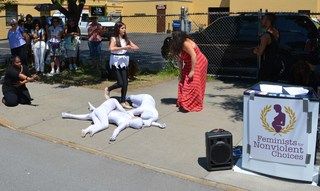
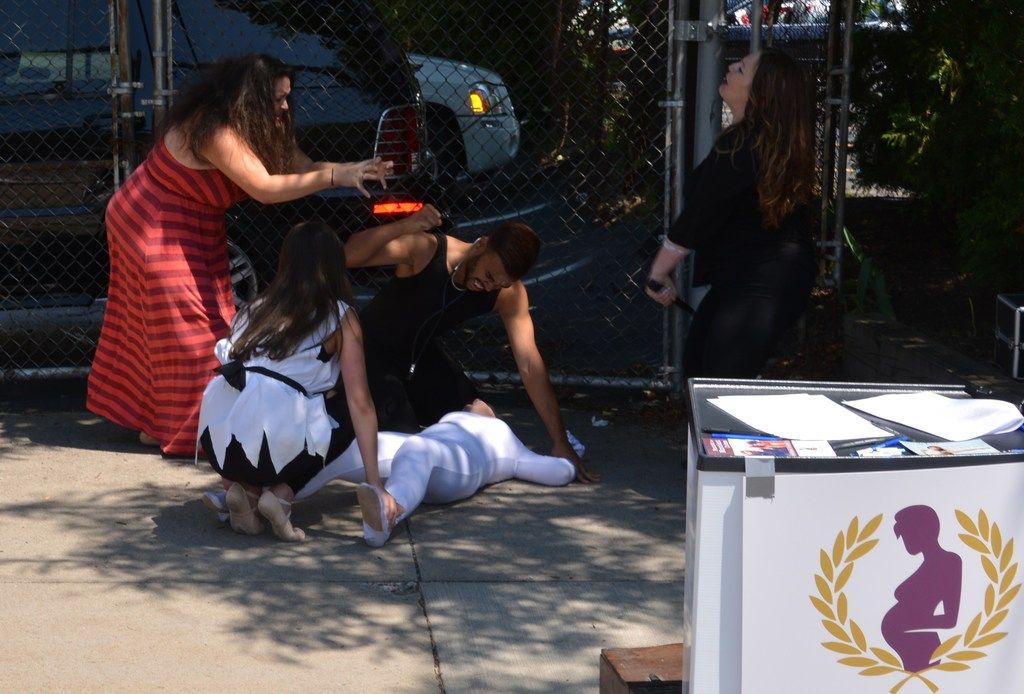
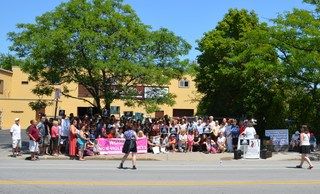
Some images from today's Women Betrayed rally at Planned Parenthood to protest the harvesting of aborted babies' organs for profit, and, of course to support life and women. 125-150 prolifers took part.


The rally included a dramatic dance performance depicting the horrors of an abortion.

There were more there, but they left before this group photo.
Pax et bonum
Saturday, July 25, 2015
Another Margaret Sanger one
The eugenic beliefs of Margaret Sanger
appealed to a certain Austrian paper hanger.
If he was still around to see her Planned Parenthood,
he'd likely declare, "Mein Gott, they're good!"
Pax et bonum
Friday, July 24, 2015
Planned Parenthood clerihews
Dr. Mary Gatter
was coy and even joked amid the chatter,
but her haggling over the price of a baby's heart or liver
made me shiver.
Dr. Mary Gatter
treated it as a laughing matter,
but sell enough baby parts, even that teenie,
and you might afford a Lamborghini.
Pax et bonum
Thursday, July 16, 2015
A few prolife poems
The recent revelation that Planned Parenthood has been selling aborted baby body parts prompted a number of exchanges on social media - you know I couldn't keep quiet! - and even a couple of bad haiku:
Planned Parenthood has
baby body parts for sale – Swift sues for a cut
Planned Parenthood has
baby body parts for sale – zombies lining up
Not good, I know. But topical.
And then there are two clerihews:
Dr. Mary Gatter
was coy and even joked amid the chatter,
but her haggling over the price of a baby's heart or liver
made me shiver.
Dr. Mary Gatter
treated it as a laughing matter,
but sell enough baby parts, even that teenie,
and you might afford a Lamborghini.
And a new one:
Hitler and Stalin
were bawlin'.
It seems abortion doctors had outdone
their best efforts with gas, bomb, and gun.
Those efforts made me wonder about other pro-life poems I've written. A few I recall:
nurse avoids looking
in garbage pail she empties – abortion clinic
praying pro-lifers –
girl entering the clinic avoids eye contact
Mass for life –
tearful woman prays for child she did not have
Holy Saturday –
praying at Planned Parenthood for the emptied wombs
I'm pretty sure there are more. I will search for them. There's also a couple of songs I wrote for a 40 Days for Life opening rally. I need to find those!
A baby by any other name would still have rights
A recent series of exchanges prompted by the revelation that Planned Parenthood is generating income by selling aborted baby parts reminded me of a line from William Shakespeare's Romeo and Juliet:
"A rose by any other name would smell as sweet."
Juliet delivered the line. She was saying that who Romeo was, the essence of this young man with whom she was falling in love, would remain no matter what name he had.
The exchange that reminded me of the line was a pro-choice woman's refusal to refer to the unborn child targeted for abortion as either a child or a baby. She stuck to "fetus."
Now we could compromise. According to Webster's Dictionary, a fetus is human being, so we could just refer to these targets of abortion as human beings. Abortion would then be the killing of a human being.
She avoided dealing with that description. So have other pro-choicers with whom I've debated.
That's dangerous territory for them, because it would be an admission about what abortion really is.
As part of my argument I pointed out that there is historical precedent for refusing to call certain groups of people "human beings."
Slave traders, for example, referred to slaves by such euphemisms as "merchandise" or "cargo" or "goods." To admit that slaves were human beings would have caused problems.
During the Rwandan massacre, the members of the targeted tribe were called "cockroaches."
I once read an account of a U.S. Army officer whose troops slaughtered Native American women and children. When asked why he killed the children, he reportedly responded, "Nits become lice."
During various U.S. wars, troops have come up with alternative names for the enemy - Krauts, Nips, Gooks, Towel Heads, and so on.
All of these euphemisms help to make the targeted groups seem less human. In the case of war, it's a bit more understandable. It's hard to kill someone whom we recognize as a fellow human being. I am not a fan of war, but it does make sense why they feel the need to do this.
But we are not at war with unborn children.
Even if pro-choicers want to call them "fetuses" or "products of conception" or whatever distancing terms they want to come up with, those children remain human beings. That is their essence. That's what their DNA says. That's what common sense says they are.
That's why parents-to-be refer to a child in the woman's womb as their baby. That's why when a woman suffers a miscarriage she will say she lost her baby.
A baby by any other name is still a living human being, with the natural rights due to him or her as a human being.
Pax et bonum
Wednesday, July 15, 2015
John Bradburne, Franciscan poet
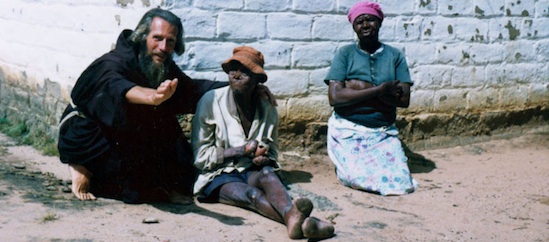
As I was preparing material for a Franciscan related event I stumbled across John Bradburne, ofs, who is being considered for canonization. He was also a poet - and you know I'm always on the lookout for Franciscan poets.
In his case, though, he wrote reportedly more than 6,000 poems. Amazing.
First, some details.
A biography based on information in part from the site of the John Bradburne Memorial Society :
John Randal Bradburne was born in Skirwith, Cumbria, England, on June 14, 1921, the son of an Anglican clergyman. He joined the army in 1939, and served in Malaya and Burma, before being invalided home. He underwent a conversion experience in Malaya, and became a Roman Catholic in 1947. He wanted to join the Carthusians, but they turned him down because he had been a Catholic less than two years. Then he got the urge to travel, and for 16 years wandered between England, Italy and the Middle East, reportedly "living out of a Gladstone bag." In 1956, he became a Secular Franciscan.
After all the years of wandering, he wrote to a friend, Father John Dove, in Zimbabwe asking "Is there a cave in Africa where I can pray?" He went there and in 1962 he confided to a Franciscan priest that he had three wishes: to serve leprosy patients, to die a martyr, and to be buried in the habit of St Francis.
In Zimbabwe he became a missionary helper, and in 1969 he was appointed warden at the Mutemwa Leprosy Settlement
He battled management over the care and treatment of the residents, and was eventually fired. He then lived in a prefab tin hut, lacking water and sanitation, just outside the leprosy compound. From there he continued to help the lepers as much as he could.
As a Secular Franciscan, he sang daily office of Our Lady, rose at dawn for Matins, and ended his day with Vespers and Compline.
During the Zimbabwean civil war, his efforts to prevent exploitation of the leprosy patients brought local hostility and suspicion. He refused to leave the place for safety and was abducted and on September 5, 1979, he was shot and killed. Some who know him or of him call him a martyr, which would certainly start him on the path to canonization.
Since his death many unusual events have been reported in relation to his name. His lasting legacy is that Mutemwa is now a place of pilgrimage, and there is a growing movement in support of his cause for sainthood.

So now for the poetry.
I have read very little of it, so I can't attest to its quality yet. But here are a few excerpts from his poems:
An artist on his canvas looks
And masters what he sees,
At writer making brighter books
Gazes each page to please:
So too The Father at the Son's
Image of Him delights, and ones
Through Love Proceeding tween the Twain
Son with The Father back again.
(from "Sitting on a Log:)
I universal am, reverse my name
And backwards barks it "God!", so call me then
By sound less holy, hollow "Hound!", - I men
Befriend from end to end, make world the same
Throughout thereby and homely everywhere
Becomes if I am present, ...
(from "Dog")
Francisca is the stillest spirit here
Indwelling with a body passing frail,
To her I think the cry of chanticleer
Frequently means an archangelic hail!
(from "Francisca (1972)")

More to read and explore.
Pax et bonum
Subscribe to:
Posts (Atom)