As part of my formation, I read some selections concerning penance.
My notions about penance tend to focus on two areas.
The first is about making up for sins. Penance is the things we do to atone in some way for those sins - saying prayers, giving up something, doing something of a spiritual nature.
The second is about uniting in love with Christ in his suffering. It is sharing in that suffering in some way - during prayer by meditating on what he experienced.
But the selections touched on an idea that I had really not thought about.
We perform acts of penance to help clear away all those things in our lives that keep us from seeing God and his love clearly. It is working to remove all the obstacles to accepting God's love - the greed, the lust, the gluttony, the pride.
The hatred for the body that Francis spoke of is not a negative rejection of the flesh - it is a recognition that there are some aspects of the flesh that blind us and keep us physically, emotionally and spiritually unhealthy. So, for example, we give up sexual activities not because sex is bad, but because those particular activities separate us from God.
We give up these things so that we are open to the love of God that is always there, always showering us.
Penance then becomes a way to become healthy individuals, individuals who recognize what is true, what is real - the Love of God. Even when we face physical infirmities, the effects of aging, the mental and emotional pressures put upon us by the world, we still have a healthy view of reality. Thus while in the eyes of the world we appear to be suffering when we face such troubles, we are actually fully healthy in spirit.
We are full of joy, for we realize how loved we really are.
Alleluia!
Pax et bonum
Saturday, April 10, 2010

Saturday, April 3, 2010
Good Friday Meditation
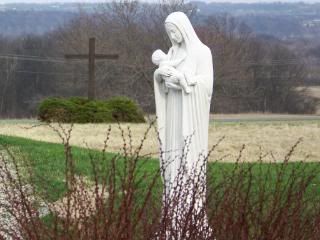
Thank you Lord
for your two great gifts -
the gift of your birth
and the gift of your death -
for it is through both
that we have been saved.
Pax et bonum
Tuesday, March 30, 2010
Persecution comes in many forms
At our SFO meeting last week, I started the Candidacy lessons (though I will not be officially accepted as a novice until, God willing, next meeting). Then I joined the rest of the group to talk about the writings of St. Francis, which they are studying as part of ongoing formation.
They were talking about Chapter XVI of the "Earlier Rule." This chapter concerns "Those who are going among the Saracens and other nonbelievers."
One person pointed out that the chapter deals with those who are placing themselves in situations in which they might become martyrs for the faith. The person lamented that we don't have those opportunities as easily today, and implied that we are somehow "weaker" for not seeking out martyrdom ourselves.
I pointed out that the rule was for the members of the first order, not us SFOs. We Secular Franciscans have vocations as lay people, husbands, parents, and workers in the world, and we are not as free to seek martyrdom deliberately (though we might face it anyway).
I also noted that we face different kinds of martyrdom. Whenever we stand up for the our faith, whenever we defend the Church, whenever will live as Catholics in the world, we proclaim the faith, and we face possible persecution. We might be ridiculed, or subject to constant verbal attacks, close scrutiny, knowing looks, and so on.
I reported that recently, for example, I had been drawn into a debate with others over the papacy, Africa, AIDs, birth control and condoms at a gathering after my father's funeral! (My mind was understandably distracted; I don't think I did as good a job as I should have.)
The portion of the rule we were discussing says one way to witness is "not to engage in arguments or disputes, to be subject to every human creature for God's sake (1 Pet 2:13) and to acknowledge that (we) are Christians." So simply by living according to the faith and not being afraid to admit what we are, we are "preaching" - and we might be persecuted. At the simplest level we might be labeled as a "religious fanatic," and thus in that way dismissed.
I am one of those prone to arguing and disputing, though I lack the knowledge and patience to do so effectively at times. I should not stop doing that when I can do so in an appropriate way, but I also need to remember that I can preach by simply living out my faith. I need to remember that if I have a reputation as a believer, I have to be careful that all of my words and actions are in keeping with the teachings of the faith and the example of St. Francis.
Pax et bonum
They were talking about Chapter XVI of the "Earlier Rule." This chapter concerns "Those who are going among the Saracens and other nonbelievers."
One person pointed out that the chapter deals with those who are placing themselves in situations in which they might become martyrs for the faith. The person lamented that we don't have those opportunities as easily today, and implied that we are somehow "weaker" for not seeking out martyrdom ourselves.
I pointed out that the rule was for the members of the first order, not us SFOs. We Secular Franciscans have vocations as lay people, husbands, parents, and workers in the world, and we are not as free to seek martyrdom deliberately (though we might face it anyway).
I also noted that we face different kinds of martyrdom. Whenever we stand up for the our faith, whenever we defend the Church, whenever will live as Catholics in the world, we proclaim the faith, and we face possible persecution. We might be ridiculed, or subject to constant verbal attacks, close scrutiny, knowing looks, and so on.
I reported that recently, for example, I had been drawn into a debate with others over the papacy, Africa, AIDs, birth control and condoms at a gathering after my father's funeral! (My mind was understandably distracted; I don't think I did as good a job as I should have.)
The portion of the rule we were discussing says one way to witness is "not to engage in arguments or disputes, to be subject to every human creature for God's sake (1 Pet 2:13) and to acknowledge that (we) are Christians." So simply by living according to the faith and not being afraid to admit what we are, we are "preaching" - and we might be persecuted. At the simplest level we might be labeled as a "religious fanatic," and thus in that way dismissed.
I am one of those prone to arguing and disputing, though I lack the knowledge and patience to do so effectively at times. I should not stop doing that when I can do so in an appropriate way, but I also need to remember that I can preach by simply living out my faith. I need to remember that if I have a reputation as a believer, I have to be careful that all of my words and actions are in keeping with the teachings of the faith and the example of St. Francis.
Pax et bonum
Saturday, March 27, 2010
Failing as a follower
At school yesterday I got angry. That happens. That's human.
But I acted on it.
A troublesome student pushed all the right buttons, and I responded harshly, saying things to her that I know I should not. I reacted in anger.
There is too much anger in me. I have not given it over to God. I have not asked for the healing I need.
The fact that my spiritual life has been out of whack for more than a month now does not help. Had I been praying, had I been more consistent, maybe I wouldn't have spoken the way I did. I would have been more open to God's help and strength.
But I haven't been. I wasn't open. I failed.
Pax et bonum
But I acted on it.
A troublesome student pushed all the right buttons, and I responded harshly, saying things to her that I know I should not. I reacted in anger.
There is too much anger in me. I have not given it over to God. I have not asked for the healing I need.
The fact that my spiritual life has been out of whack for more than a month now does not help. Had I been praying, had I been more consistent, maybe I wouldn't have spoken the way I did. I would have been more open to God's help and strength.
But I haven't been. I wasn't open. I failed.
Pax et bonum
Saturday, February 27, 2010
Snow - but onward
The retreat in early February took the place of our regular meeting. It was a wonderful experience, by the way.
Last night, the meeting got cancelled due to the snow storm that hit the Rochester area.
It is just as well. With dad in the hospital, I was able to pop over again to see him last night.
But still, I was looking forward to the meeting - I need a spiritual boost with all that's going on. And I've had no formal formation sessions in a month since completing the Inquiry phase.
Patience.
The formation director called and left a message to let me know the meeting was cancelled. Then he said I should just go ahead and read the first candidacy session material, even though I am not officially a candidate yet. I will gladly do so.
Pax et bonum
Last night, the meeting got cancelled due to the snow storm that hit the Rochester area.
It is just as well. With dad in the hospital, I was able to pop over again to see him last night.
But still, I was looking forward to the meeting - I need a spiritual boost with all that's going on. And I've had no formal formation sessions in a month since completing the Inquiry phase.
Patience.
The formation director called and left a message to let me know the meeting was cancelled. Then he said I should just go ahead and read the first candidacy session material, even though I am not officially a candidate yet. I will gladly do so.
Pax et bonum
Saturday, January 23, 2010
Formation - another step
Last night we completed the material for the Inquiry Phase of formation. The next step is the "Admission of Candidates" - in my case, the "Candidate" since I'm still solo.
I'm not certain when that will officially happen. Our next meeting is a Day of Recollection with Father Anthony, so no "meeting" per se. The next meeting is scheduled for February 26.
We talked about my struggles with prayer. Not making enough time. Not remaining focused - mind wandering.
I often say the rosary while driving, for example. It's hard to meditate on the mysteries while worrying about that semi on the right. And I tend to read the Bible before bed - when my brain drifts off because I'm tired.
Someone previously suggested the Liturgy of the Hours as one practice. I dug out my book and said the morning prayers today. I will try to do that every day - and to cut down on pre-dawn wasting of time on the computer.
I will try to read the Bible during the day - and to spend some time meditating.
I will try to get in a rosary when NOT driving.
I'm good at saying all the right things, so I can seem like I'm progressing. But I will not really grow unless my prayer life improves.
Pax et bonum
I'm not certain when that will officially happen. Our next meeting is a Day of Recollection with Father Anthony, so no "meeting" per se. The next meeting is scheduled for February 26.
We talked about my struggles with prayer. Not making enough time. Not remaining focused - mind wandering.
I often say the rosary while driving, for example. It's hard to meditate on the mysteries while worrying about that semi on the right. And I tend to read the Bible before bed - when my brain drifts off because I'm tired.
Someone previously suggested the Liturgy of the Hours as one practice. I dug out my book and said the morning prayers today. I will try to do that every day - and to cut down on pre-dawn wasting of time on the computer.
I will try to read the Bible during the day - and to spend some time meditating.
I will try to get in a rosary when NOT driving.
I'm good at saying all the right things, so I can seem like I'm progressing. But I will not really grow unless my prayer life improves.
Pax et bonum
Saturday, January 16, 2010
Pontiff praises Dominicans and Fransciscans
In his General Audience January 13, Pope Benedict XVI praised the Dominicans and the Franciscans - and secular orders.
He noted that these two orders were among the mendicant orders that arose in response to a need in the 13th Century.
"Of the Mendicant Orders that arose in that period, the most notable and most important are the Friars Minor and the Preaching Friars, known as Franciscans and Dominicans. They have these names because of their founders, Francis of Assisi and Dominic de Guzmán, respectively. These two great saints had the capacity to wisely read `the signs of the times,' intuiting the challenges that the Church of their time had to face."
He observed that some of the mendicant groups that arose at that time embraced poverty, but rejected the Church. But "the Franciscans and Dominicans, in the footsteps of their founders, showed that it was possible to live evangelical poverty, the truth of the Gospel, without separating from the Church; they showed that the Church continued to be the true, authentic place of the Gospel and Scripture. Thus, Dominic and Francis drew, precisely from profound communion with the Church and the papacy, the strength of their witness."
These two orders "taught ways to nourish the life of prayer and piety. For example, the Franciscans greatly spread devotion to the humanity of Christ, with the commitment of imitating the Lord. Hence it is not surprising that the faithful were numerous, women and men, who chose to be supported in their Christian journey by the Franciscan and Dominican friars, sought after and appreciated spiritual directors and confessors.
"Thus were born associations of lay faithful that were inspired by the spirituality of Sts. Francis and Dominic, adapted to their state of life. It was the Third Order, whether Franciscan or Dominican. In other words, the proposal of a "lay sanctity" won many people. As the Second Vatican Council recalled, the call to holiness is not reserved to some, but is universal (cf. "Lumen Gentium," 40). In every state of life, according to the needs of each, there is the possibility of living the Gospel. Also today every Christian must tend to the "lofty measure of Christian life," no matter what state of life he belongs to!"
I found his words affirming. I do wish he had gone further and encouraged people to join the secular orders! I guess that's up to us.
You can read the rest here.
Pax et bonum
He noted that these two orders were among the mendicant orders that arose in response to a need in the 13th Century.
"Of the Mendicant Orders that arose in that period, the most notable and most important are the Friars Minor and the Preaching Friars, known as Franciscans and Dominicans. They have these names because of their founders, Francis of Assisi and Dominic de Guzmán, respectively. These two great saints had the capacity to wisely read `the signs of the times,' intuiting the challenges that the Church of their time had to face."
He observed that some of the mendicant groups that arose at that time embraced poverty, but rejected the Church. But "the Franciscans and Dominicans, in the footsteps of their founders, showed that it was possible to live evangelical poverty, the truth of the Gospel, without separating from the Church; they showed that the Church continued to be the true, authentic place of the Gospel and Scripture. Thus, Dominic and Francis drew, precisely from profound communion with the Church and the papacy, the strength of their witness."
These two orders "taught ways to nourish the life of prayer and piety. For example, the Franciscans greatly spread devotion to the humanity of Christ, with the commitment of imitating the Lord. Hence it is not surprising that the faithful were numerous, women and men, who chose to be supported in their Christian journey by the Franciscan and Dominican friars, sought after and appreciated spiritual directors and confessors.
"Thus were born associations of lay faithful that were inspired by the spirituality of Sts. Francis and Dominic, adapted to their state of life. It was the Third Order, whether Franciscan or Dominican. In other words, the proposal of a "lay sanctity" won many people. As the Second Vatican Council recalled, the call to holiness is not reserved to some, but is universal (cf. "Lumen Gentium," 40). In every state of life, according to the needs of each, there is the possibility of living the Gospel. Also today every Christian must tend to the "lofty measure of Christian life," no matter what state of life he belongs to!"
I found his words affirming. I do wish he had gone further and encouraged people to join the secular orders! I guess that's up to us.
You can read the rest here.
Pax et bonum
Subscribe to:
Posts (Atom)